I improvised some birthday oatmeal cookies for the dancer’s birthday. Starting with the Momofuku Milk Bar recipe:
- 1 stick butter at room temperature
- 80g brown sugar
- 50g sugar
- 1 egg yolk
- 80g flour
- 120g rolled oats
- 1/4 t baking powder
- pinch baking soda
- 3/4 t salt
This makes a nice, sweet, salty cookie. Since it’s a birthday cookie, I added a big handful of dried cherries and a small handful of pistachios. (Don’t go overboard on the nuts). Cream the sugar and the butter, then beat in the egg yolks, then add the rest until everything comes together.350° for 15min.
by Christina Tosi

On a dreary day last December, I grumbled my unseasonal way into the local Barnes and Noble for some distraction and solace. What I found was a petty deception: a table filled with intriguing new cookbooks – Adria’s Family Meal, an intriguing cocktail book, and Christina Tosi’s new Momofuku Milk Bar
I finally got my copy of the book last night at a special demo meal at Stir, a small Barbara Lynch space that offers nightly demo dinners. Stephanie Cmar and Caitlin Hannegan worked out a nice solution to the problem of an evening demo based on a dessert cookbook.
- Steamed buns (shiitake, kimchi) ❧ NV Simonet-Fabvre Crémand de Bourgogne
- Roasted rice cakes, red dragon sauce ❧ 2009 Laurent Kraft Vouvray Sec
- Ramen (pork belly, pork shoulder, egg) ❧ Brooklyn Brewery Sorachi Ace
- Birthday Cake ❧ 2010 Balletto Pino Noir
- Crack pie
I might have been tempted to add one more small dessert, either as a mignardise or maybe as an amuse, but there’s a lot of sugar in this meal: that red dragon sauce with the rice cakes is deliciously spicy and savory, but in essence it’s a spicy simple syrup.
Most of the other students, oddly enough, were not terrifically interested in food and cooking. One was a cook at another Barbara Lynch property; I fancy he didn’t ask questions because he can ask anytime. The others were very eager to talk about Boston and New York restaurants, and everyone spent a lot of time discussing Top Chef.
I’m really surprised by this. OK: I’ve been reading The Hunger Games, in which reality TV is evil incarnate, and my own television was stolen last summer. But still: if there were a Top Programmer, I can’t imagine wanting to follow it. Either the participants would be really good, which would be depressing, or I’d be constantly complaining that I can do that.
This was obviously a tasty meal, and Tosi’s desserts are filled with intriguing ideas. Two strike me offhand:
- Lots of effort goes into polishing the surface of contemporary desserts, to making them look great. We don’t do this with our food anymore; we don’t fold napkins into pheasants and we don’t bake our gamebirds into a pie shaped like a hawk, the way Escoffier and company used to. Let the rough edges show on the cake.
- Kids love dessert. In addition, dessert is for us forbidden food. Dessert is gooey and gloppy and colorful. All this makes it an opportunity to reflect on childhood and to exploit the memory of lost flavors, recherches du temps perdu and those forgotten madeleines. But we didn’t have madeleines, so for us it’s infusions of Fruit Loops. Which reminds me: I owe you all a discussion of Next:Childhood. Soon
Cmar did a nice job, considering her audience wanted to gossip about television and where they eat in the financial district and how one of the local bistros no longer serves their favorite tea. It’s not an easy job. Of course, when you’re twenty-something and a grizzled veteran line cook/sous chef who got into this work as an alternative to burn out (“And who wants to listen to a 24-year-old complain about burnout?” she muses), working an audience while demoing some other cook’s unfamiliar dishes has got to be a bit of a challenge. I managed to get a few question in without obviously alienating the rest of the gang.
From my notes:
- The mushrooms for the steamed buns had been quickly sauteed, then deep fried (90 sec) after having been dusted with tapioca flour. They were great; Caitlin was snacking on them after the course. It’s an interesting technique, almost a tempura batter that makes itself with the mushroom’s juices. I still don’t understand how you get the sauté pan oil off the mushrooms, or, if you don’t, what keeps the tapioca flour from turning into a pasty mess. Worth trying, though!
- If you want to make your own Kimchee, the right brand of Kimchee Mix is made by Noh.
- The ramen was based on a very nice broth. Not much was said about that, I suppose because this class didn’t look like anyone was going to rush off and make stock. But I think it’d be very interesting to know more. I often discard the braising liquid when I make picadillo or Carolina barbecue; would that be a starting point for the Ramen broth? Or would the Ramen broth be a better braising liquid?
- They make disposable pastry bags! Who knew?
- There’s baking powder in the birthday cake frosting. Why? (I raised my eyebrows, and Cmar took the hint and said she’d already checked McGee and still didn’t know. Not informative, but that made me feel salty as hell.)
- Pairing the pinot noir, which is not a sweet or even fruit-forward wine, with the desserts raised my eyebrows. It worked for me, but I'd like to know more about the thinking here. Are we simply avoiding tannins (in which case a Malbec or Grenache might work) or looking for acid, or what?
Throughout the meal, we watched the cooking and then Cmar plated off to the side. This was too bad. It happens that a bunch of the dishes don’t have very interesting technique for final prep; if you’re reheating a pork belly in broth, there’s not that much to see. And all the mise was done in advance – I don’t think Cmar touched a knife before slicing the cake – so we didn’t learn anything about knife skills. I have absolutely no idea how to plate, and it’s just not something anyone writes about; I’d like to see it. (This may be because people are squeamish about knowing that cooks touch their food, but let’s grow up.)
Stir does quite a few of these cookbook/dinner tie-ins. It’s a very interesting concept, a signing (though in this case the author wasn’t even present – I got Cmar to sign, though, which will be just as good someday) which nets more than $100 per person over the price of the book. They regularly blow out the doors on these, it seems, though Hannegan said that much depends on the skill of the publicist. As a business proposition, it sure beats conventional signings which can sometimes feature three tired passers-by who wandered in from the rain.
I’m looking forward to reading the book. I do wish that cookbooks were less cagy about their ghost writers. And I don’t know how much I’ll be able to cook: Linda’s on a diet, lots of my guests are avoiding carbs, and everybody avoids fat. But I’ve got to try some of this.
Is there a decent source for kitchen tech support, beyond one’s mother?
For example, my focaccia always turns out to be bread of some sort. My ancestors were not always so lucky. Still, it is never the light and airy sort of focaccia you get at Iggy’s. The same dough makes ciabatta with a nice crust, but it’s dense and fine-grained, too.
What am I doing wrong? Not enough liquid? Not enough rising time? Wrong kind of yeast? Too much or too little of something else?
OK: Cook’s has shown us that a little systematic lab work will solve problems like this. But I don’t want to do the research: this has got to be common knowledge, but who are you going to call?
Update: See cooking.stackexchange.com
A cousin form California whom I see too seldom came for dinner.
- Linda’s retro chip dip ❧ peppers stuffed with goat cheese ❧ aviations
- carrot ginger soup ❧ sprouted wheat bread (Pullman)
- salmon with lentils several sauces
- roast beef ❧ posole ❧ Yorkshire pudding
- Meyer lemon jelly ❧ blood orange sorbet
Most of this is familiar and went as predicted. The Yorkshire puddings came out OK, but were not nearly as tasty as the ones I had in London. Predictable, I suppose.
“Don’t doctor recipes. More is less, and sugar will only get you so far.”–Allegra Goodman, The Cookbook Collector
The bread turned out really well. This was another experiment, a doctored version of Ruhlman’s 5:3 focaccia.
- 25 oz flour (20 bread, 5 sprouted wheat)
- 17.5oz water (6 buttermilk, 11 water)
- 2t salt, sprig rosemary
- 1t yeast
Refrigerated overnight, top slashed and brushed with egg, baked in a buttered Pullman loaf pan at 425°F.
My breads all tend to be dense, so I tried cheating a bit by adding extra liquid. The rising went very slowly, perhaps because the kitchen was cold. I’m not sure whether the extra liquid helped.

- salmon rillettes (we’re fresh out of fat squirrels)
- Prim’s peppadew peppers and goat cheese
- fennel, pear, and sparkling cider soup
- katniss squash soufflé ❧ onion tart
- Hob posóle ❧ carolina BBQ ❧ district 11 rolls
- roast Giannone grooslings
- nightlock berry jelly
- blood orange sorbet ❧ candied orange peel
- pets de “game maker”
- mignardises: chocolate mud biscuits and orange shortbread
For a book about hungry people The Hunger Games
Too much, really. The chicken was meant to be accompanied by the posole and barbecue, but a slow oven meant it had to follow it. Oh well.
I was particularly proud of the District 11 rolls, which feature prominently in the book and which are the first bread recipe I improvised. They're supposed to be rustic; I added some sprouted wheat flour and a good deal of molasses, and for liquid I used 50% buttermilk and 50% water. They’re supposed to be seedy; I used 2T of caraway and could have used more. I’d not made crescent rolls before, but I’ve seen a YouTube demo of croissants; they came out fine. An egg yolk glaze did no harm.
The blueberry jelly was a bit disappointing, of only because the cherry and lemon jellies I’ve made before were so intensely fruity. The blood orange sorbet was a winner.
Ran into Stop and Shop at midnight on the way home to grab some milk, and also bought a quart of buttermilk while I was there because, ironically, Stop and Shop stocks better buttermilk than Whole Foods.
“What are you going to do with the buttermilk?” asked the cashier, who was lonely and at the end of her shift.
“Pancakes, of course.”
“I wish I had time to make pancakes in the morning!”
I forbore to suggest that she find a nice fellow (gender to taste) who would get up a little early and make her some pancakes. Instead, I gave her the party line, that cooking doesn’t really take much time.
It seems to me that the right way to do this, if you’re not a morning person, is to mix your dry ingredients the night before.
- 3/4 c flour
- 1/2t salt
- 1T sugar
- 3/4 t baking powder
- 1/2 t baking soda
- a handful of crushed pecans if you like them
Then in the morning, all you have to do is heat some butter in the pan. While it's heating, start the coffee. Then you throw in
- 3/4c buttermilk
- 1 egg
and you stir it a few times with a wooden spoon. You don't have to get the lumps out or anything—just get everything mixed together. Spoon it out into the hot pan. Flip. Eat.
Discovery when doing snack support for last weekend’s Tinderbox: the donuts at Ohlin’s Bakery in Belmont are exceptional.
- gougères ❧ vanilla pecans ❧ Linda’s retro onion dip ❧ lavender cheese thimbles
- Whiter shade of ale: cream of cauliflower soup garnished with creme fraîche and smoked pistachio brittle
- Frivolity and wisdom: ravioli nudi with chard and Bennington artisanal ricotta in sage butter sauce
- Field work: roast leg of lamb (rubbed in roasted garlic and rosemary) with mushroom sauce ❧ bread pudding with caramelized onion and goat cheese ❧ lentils in champagne ❧ roasted shallots
- Red hot and cold: cherry jelly ❧ mai tai jelly ❧ pecan pie
- Clotilde’s chocolate biscuits ❧ coffee
For a change, I actually managed to make (and remembered to serve) all the planned dishes, and prep went about as well as it could. Some of the dishes took a surprising time, mostly because my stock reserves are low. The mushroom sauce entailed a chicken double stock, the lentils needed a vegetable stock, and those caramelized onions in the bread pudding took the better part of five hours. Once that was out of the way, I could get down to business. All’s well that ends before dinner time, broadly construed.
The huge Colorado leg of lamb (the checkout clerk at the store asked if it was a goat) worked really well.
We used just about every spoon and fork we possess, and could have used more.
A weeknight dinner for a night-owl friend.
- cream of broccoli soup
- pasta gratin
- hanger steak
- salt-roasted potatoes
- romaine salad
- Meyer lemon jelly
The lemon jelly worked nicely in my new set of jelly molds ($2.29 from eBay). The soup was flat, which surprised me after a much simpler cauliflower soup I made earlier in the week.
by Harry Parr and Sam Bompas

This delightful little cookbook explores the lost Victorian craft of jellied desserts. Using good gelatin and real food is a revelation to people accustomed to the flavor and texture of Jell-O™. The glow-in-the-dark gin and tonic jelly was great. Linda says that last night’s cherry jelly, made with frozen cherries, was the best cherry dessert she’s ever tasted.
I wasn’t planning to have a dinner, but the store had fresh brined turkeys at an unusual price. It seemed like tasty fun.
- Non-violent violet gin jellies that glow in the dark
- Apple-rosemary-cinnamon caviar (stand back! I’m going to use… Science!)
- Winter-grilled turkey (playing with matches)
- Root Mus (root for the moose?)
- Caramelized onion focaccia cracker (play dough)
- Spinach Salad
- Fruit crumble with whipped cream
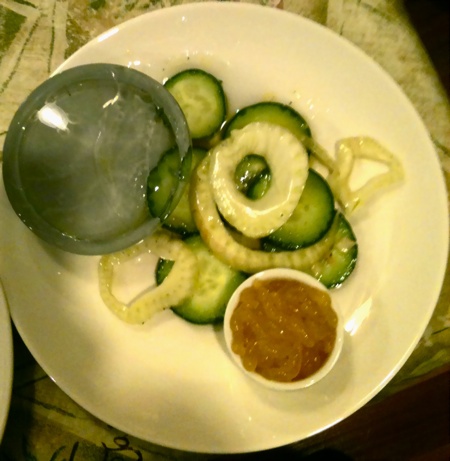
The gin and tonic jellies are based on Bompas and Parr’s Jelly Mongers
I bought my premium sheet gelatin from The Modernist Pantry, and picked up a spherification kit while I was at it. I thought I'd start out with rosemary-infused apple caviar, even though Cathy Marshall insisted that this would not work without an applefish. The results were tasty but more tubular or tuberous than spherical; I suppose my alginate suspension was too viscous.
What happens when you make an onion focaccia, and forget it's in the oven? Caramelized onion focaccia crackers! Actually edible, or nearly so.
by Claudia Roden

Did you know about Moroccan Hanukkah donuts? Neither did I.
They're called svenj.
And fortunately Claudia Roden knows all about them, and tells. What’s more, they’re incredibly easy, probably the easiest and most forgiving dough I’ve met. They’re made with orange juice (good for you!), you can add some whole wheat flour to the dough without catastrophe (health food donuts!).
This is an interesting cookbook because, while it’s about Jewish food, Roden is from Egypt and she doesn’t have a great deal of interest in Ashkenaz cooking, which after all is what most people I know think about when someone says as “Jewish food.” These recipes derive mostly from North Africa but some come from really far afield, like the Bene Israel cuisine of India.
The recipes tend to be simple and straightforward, with few tricky techniques or really exotic ingredients. This is, I think, the cooking of grandmothers in nice modern apartments who are making do with what the new world provides. But then, their grandmothers were making do, too; the spirit of the thing isn’t that different, and great grandmother probably complained that food today wasn’t nearly as good as it was in her youth. I wish there were more charcuterie and preserved foods; I learned to make pastrami from Ruhlman and that’s always a hit. But there’s plenty to try here in any case, and it’s interesting food even if you aren’t part of the tribe.
A happened to glance at Twitter at just the right moment and saw that Next had released the last batch of tickets to its Childhood menu. And, as it happens, I'm going to Chicago to visit Mom shortly, since Linda has a history conference there.
And there was one table left during our trip.
So, looks like you can go home again – it’s just kind of expensive.
Yay.
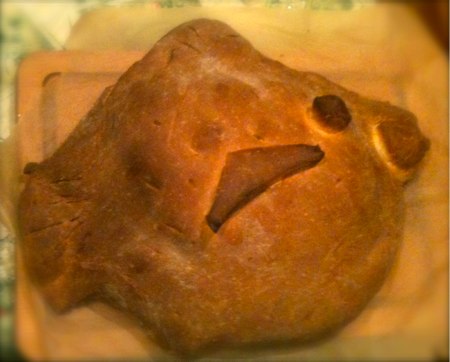
An old friend was coming to dinner after a nasty bicycle accident and surgery. She doesn’t eat meat or cheese. It’s too late in the year for really great vegetables.
- Red Alert! red pepper and sumac soup with lemon yogurt, onion focaccia with cranberry ginger chutney
- White on white.Celery root remoulade, with small chunks of home-smoked haddock.
- We’re really in hot soup now! Homemade pumpkin ravioli in fennel broth, garnished with strange mushrooms
- Foods that even Julia Child cannot pronounce right/From cookbooks that time has forgot. Coulibac of salmon with mushroom duxelles and quinoa, with baby brussels sprouts, balsamic peppers, and cilantro aioli
- Salad.
- Will Robinson Apple crisp
- You’re a brick! Chocolate pavé
- Where there’s smoke… Smoked pistachio brittle
- Fire! Clotilde’s fiery chocolate biscuits
The real danger is that we’ve only got two substantial courses – the ravioli and the coulibac – and both are going to be high-wire acts: I’ve never done them before, they require assembly, and both are prone to spectacular failure at the last moment.
Would the coulibac turn into mush or crumble to bits? Would the ravioli disintegrate? And what about Naomi?
Oh dear.
The coulibac is something I’ve thought about for eons. It was in Julia Child’s Cooking for Company
You’ve seen the dish in Julie & Julia, but for some reason (oh woe!) I can’t find Julie Powell’s old blog anywhere and so can’t like to her triumphal version.
The idea is to bake a fish in a bread crust. It’s a Russian dish by way of Escoffier, which explains the whimsical name and the extravagant concept, not to mention the idea of making a pastry that looks like a funny fish and that has a fish inside it.
Here’s what you do:
- Make a big batch of brioche the night before, so the dough can ferment in the refrigerator and then rise all morning. The dough can enjoy this leisurely rise, since it is resting luxuriously in your two best mixing bowls, which leaves the focaccia to rise in your inferior mixing bowl and the rest of the meal to be prepped in castoffs, strays, storage containers, and other concave things.
- Make two pounds of mushroom duxelles. This is not really enough.
- Make a cup of quinoa, which you toast before cooking. Nobody said whether you wanted a cup before or after it was cooked, but 1c uncooked quinoa was really more than I needed. Otherwise, the inadequate mushroom duxelles might be lost entirely.
- Season and sear the fish very quickly, so it doesn’t cook but colors well.
- Make a very big crepe. Julia wants one the size of a jelly roll pan, but I settled for one the size of the griddle. Nobody really explains why the crepe is there or what it’s for. It’s Escoffier.
- Not long before dinner, you roll out the dough in two flat sheets. You can’t do this too far in advance or the dough won’t be right. You cut the dough into fish shapes. On the bottom, you layer the crepe, the mushrooms, the quinoa, and the fish. You fold the crepe over to make a fun little envelope.
- Then you lower the top crust, seal, and trim it. And use the trimmings to sculpt cute fish details. And you are supposed to carve little scales into the crust. This reminds you that should have been paying attention in 3rd grade, which is probably the last time anyone told you to make a sculpture of a fish.
- Bake and serve at once, leaving everyone hungry if something goes wrong.
It was actually pretty good, and now I understand where it’s headed. Julia adds an odd mixture of fish (I was going to use smoked haddock) and paté de choux, and now I think that would work well. Note to future: season the interior aggressively. I think it would be better if it were served, as originally intended, with lots of Hollandaise. But Hollandaise is pretty in-your-face with egg and butter. Since Ruhlman says a Hollandaise can smell fear, discretion and aioli seemed the better part of valor.
The chocolate pavé from Alice Waters’s Simple Food
by Grant Achatz and Nick Kokonas with Dave Beran

Available as an eBook from iTunes. Next is a Chicago restaurant with a unique plan that began as a fantasy. Chef Achatz had been diagnosed with tongue cancer and thought his life was over. Business partner Kokonas cajoled him: they were already on top of the food world with Alinea, so what would they do next? Achatz imagined a restaurant that would always be opening, that would have an entirely new kind of menu every three months.
So, Next opened with “Paris 1906”, recreating and reimagining Escoffier at the Ritz. The next menu was “Tour of Thailand.” The current menu, “Childhood”, is said to include a course served in a lunchbox and a course of paté de foie gras served on egg beaters – foie-sting.
This ambitious ebook explains in detail how to recreate each course of Paris 1906. Most of these are going to be out of reach of you and I; Next has a convenient supplier of farmed turtle meat for its potage a lat tartue claire, but your local fish market is not going to help you here. And who has a duck press fore caneton rouennaise a la presse?
Still, this is a fascinating exploration of classic cooking ideas, both in their turn-of-the-century forms and in modern dress. The Sûpremes de Poussin course, for example, was somewhat controversial because some people felt it was undercooked. This was, as I had speculated, the point:
Amazingly, this chicken proved difficult for some patrons. Too often, chicken is overcooked and relatively flavorless. The soft texture and hearty flavor is precisely the intended, correct effect this dish aims for, but it comes as a surprise.
There’s more going on here than meets the eye, because (unusually for this book) we have a taste here of Escoffier’s own cadence. He’s the fellow who begins his Guide by saying, “These culinary preparations define the fundamentals and the requisite ingredients without which nothing of importance can be attempted.”
And how does that little chicken course get put together? You take the chicken, butter garlic and thyme, and you cook them sous vide for 62°C for eighteen minutes. But you aren’t done! You need a blanquette base, which starts with a good chicken stock, and turns it into a double stock with a fresh lot of bones, the dark meat from the chickens, aromatics, and mushrooms. Then you take 200g of that base and add a liter of cream, 80g of foie gras, banyuls vinegar, and egg yolks. That’s your sauce.
This doesn’t look just like what you’d have seen at the Ritz back in the day, but it’s getting the same effect. Time change and we are not now that strength which in old days moved earth and heaven –that which we are, we are, and that means foie gras and labor costs are not the same for us as they were at the end of that first gilded age. Our chickens are less tasty and our knowledge greater, and we still wonder “what’s for dinner?” Any $5 eBook that can shed new light on these old questions is a terrific idea.
by Monica Ali
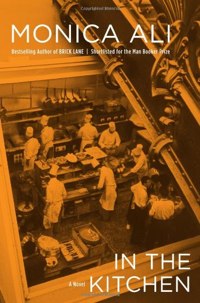
Gabe Lightfoot is the executive chef of a grand Picadilly hotel. He’s planning to leave to open his own place. He’s planning to marry Charlie, a lovely girl. His plans are about to go awry. No one in this novel is very likable, and while Ali has a nice sense of place, she doesn’t have much affection for this place, and while she does have a certain affection for these characters, it’s rather late in coming. The setting of In The Kitchen is trendy but a wasted opportunity, as nothing much happens in the kitchen that couldn't have happened back in the mill where Gabe’s father worked. Perhaps that’s the point.
- aperos:
- pear and hazelnute madeleines (pear & hazelnut)
- cruidites with onion dip
- home-smoked swordfish rillettes
- wasabi peas
- lollipops on fire (bourbon sweet potato fritters, served on smoldering cinnamon sticks)
- alliterative salad: papaya salad with pickled peppadew peppers, stuffed with goat cheese
- duck burgers on home-made brioche rolls, celery root remoulade, apple chutney, aioli
- home-made corned beef on home-made rye
- parmesan custard, romaine, anchovy dressing, parmesan crisps
- Meryl’s intense chocolate tart
- lemon cayenne cookies
The lollipops were meant to adapt an Alinea idea to human scale. At Alinea, they make three gels – bourbon, sweet potato, and brown sugar – skewer them, and then dip them in tempura batter. The fritter is less refined, but it’s much easier. It’s surprisingly hard, though, to ignite cinnamon sticks.
The papaya salad was supposed to have persimmon, too. But I tasted the persimmon as I was slicing it, and decided that persimmon, while lovely, is not really fit for human consumption. The green papaya wasn’t green, either, but the spicy fish sauce dressing worked anyway.
A Day In The Life Of A Las Vegas Casino Helper: an exceptionally well-written series unfolding at eGullet.
by Pat Crocker
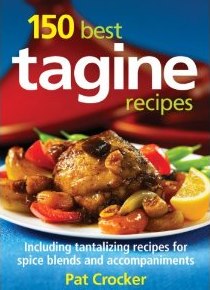
A PR firm pitched this book to me with exceptional skill, and since I’ve been wanting to explore some North African braises and stews this winter, I went along. So far, it’s been a tasty trip.
The market-imposed format promises 150 recipes, so you’ll get your money’s worth. No one needs 150 recipes. First, we don’t want 150 things to cook, not unless we’re Carol Blymire or Julie Powell
The book starts with an exceptionally good and direct rundown on tagines as cookware, including a frank and supportive discussion of the comparative merits of Le Creuset and Staub adaptations that use new materials for Western kitchens. There are good discussions of North African and Mediterranean spices and spice mixes, too. What I miss here is a clear feeling for the difference between a tagine and a partly-covered cocotte or Dutch oven.
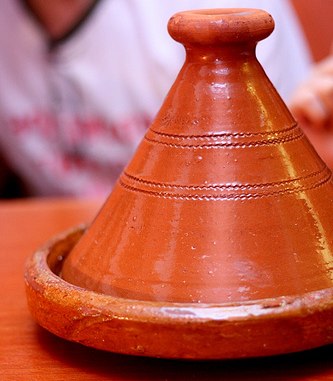
Similarly, it's not entirely clear to me, after casual leafing and after cooking a recipe or two, exactly how a tagine differs from other braising techniques – from what you might see in Provence, say. Is it mostly about spices? About cooking in water rather than stock and wine? About eating with your hands? About cooking for a very long time? Some questions of technique seem obscure, too; should we sometimes brown the meat but sometimes not? Should we brown vegetables?
Despite these objections, last night’s lamb, stewed for hours with apricot and pear and lots of berbere – a new discovery for me – was very tasty indeed. And, despite the unpromising cover, it wasn’t underspiced or timid, but had lots of full-throated heat and depth.
The July burglars waltzed off with our television. We have scant time to watch it anyway, and thus far we haven’t bothered to replace it.
I took advantage of the excuse to cut out DVDs delivery from Netflix, saving some $16/month. About a million people have done something similar, it seems. This is a drop on the Netflix ocean, but I expect one problem here is that customers like me – marginal users who don’t watch a lot of DVDs – are Netflix’s most profitable cohort.
The big loss for me was unexpected. It’s not that I miss the movies: I miss the Netflix queue. There’s no particular reason for Netflix to keep a DVD queue for someone who isn’t a DVD subscriber, but for several years I’ve used the Netflix queue to plan the next hundred movies I planned to watch. I should have exported that queue before I cancelled. Now, with Netflix spinning off the DVD business as Qwickster, I guess that queue may be gone for good.
I don’t watch that much football, but I do like to see a game sometimes. Yesterday, I walked down to the local bar to catch Patriots-Chargers. The place was busy, though I bet a lot of these folks have televisions of their own. Lots of happy Patriots fans of course.
I chatted with one fellow, a short guy in his sixties, while he waited for the bartender to pull three pints of Pabst. Gathering them up and heading back to his table, he nodded to me and actually said, in broad Boston: “See you later, pal.” It’s like the first time you meet an Australian who actually says, “G’day mate!”
I once met a pair of American academics who had gone off to live with a flock of goats and make goat cheese. They had named the goats Emily, Virginia, Jessamyn, Willa, and Ursula. It was terrific goat cheese, too. – Adam Gopnik
Next is a fascinating Chicago restaurant that serves a single, fixed menu that changes every three months. You don’t make reservations; you buy tickets. The current menu is titled “Tour of Thailand.” It’s full of fascinating ideas.
Next is owned by Grant Achatz and Nick Kokonas, the cerebral pair who created Alinea. A few years ago, I wrote a piece about one dish: Alinea: What the Pigeonneaux a la Saint-Clair are saying. Next is not pushing the same boundaries as Alinea, but there are lots of ideas in every course.
Street food: served on a table spread with fresh Thai newspapers. Roasted banana, a prawn cake, a tasty sweet shrimp, a piece of sausage, a steamed bun. All paired with a cocktail based on Batavia Arrack, guava, and mango. The roasted banana was particularly complex and unforgettable, but this is all nifty food. Asian street food is a problem: you don’t get it in the US, and eating on the street still feels chancy in the third world. There’s always Singapore, where the street food is immaculate, but this is a wonderful course.
Hot and sour broth, pork belly: familiar thom yum soup, redolent of chillis and lemongrass, kicked up a notch and garnished with an amazingly lean piece of pork belly. This seems a simple course, and you might think it’s more delicious just because they use better spices. I suspect there’s a lot going on here; I bet that pork belly, for example, is cooked sous vide for a very long time, and I bet there’s some quiet molecular wizardry going on with the broth, too. This is Achatz all over: do something really complex and don’t even mention it, letting the dish speak for itself. Paired with a cocktail of gin, chrysanthemum, lemongrass, and lychee.
Rice with condiments: just the usual – chili paste, salted duck egg, mango pickles, things like that. Except these didn’t come from a jar. I gather that Achatz doesn’t care for the duck egg, which was my favorite.
Catfish, caramel sauce. The advance story for Next promised a visit to 18th century Ayutthaya, the kingdom that preceded Thailand. This dish must be part of that vision, a memory of Thai cuisine before peppers arrived from the New World. Subtle and delicious. Paired superbly with a wine that goes by the unlikely moniker of Itsas Meni Hondarrabi Zuri, Bizkaiko Txakolina 2010.
Beef cheek curry. A big, hearty piece of beef cheek, beautifully braised, in a superb curry. Again, we’re taking familiar Thai neighborhood restaurant fare and making it better – not by using fancy ingredients like “Cadillac fajitas,” but by really thinking it through. What makes this dish is that you get one hearty piece of flavorful, perfectly braised and seasoned beef, rather than lots of little bits. Getting it right has got to be tricky, but it makes a hell of a dish. Paired with Half Acre Horizon Ale, custom-brewed for this dish with hibiscus, mangosteen and pomegranate. A terrific pairing – and I am not usually fond of fruit beers.
Clarification of watermelon, lemongrass. I wrote about this before. If you don’t pick up on the hint word “clarification”, you’d think this was just an unusual juice.
Dessert with corn, egg, licorice, service in a young coconut. A very elaborate composed dessert, worthy of Alinea for its play as well as the complex interaction of flavors and textures. This must be an absolute bear to make, but again you wouldn’t necessarily notice if you weren’t looking at all the different little products mixed together in your coconut. Journeyman in Somerville does desserts with lots of components, but they're on display; at Next, they’re casually tossed in your coconut (though it would not surprise me if the apparent casualness of the tossing is a carefully-cultivated illusion). Paired with Cusumano, Moscatto dello Zucco – a nicely acidic dessert wine.
Dragon fruit, rose water, and a rose. Perfectly delicious, served with a long stemmed rose to revive your sense of smell. Paired with Banks blended island rum, served straight. You wouldn't think raw spirit would work this late in the meal and paired with fruit, but it seems inevitable. I want a bottle, and I hardly ever drink rum.
Iced tea in plastic bags. Back to street food! Soft drinks in plastic bags are one of the details of being in Asia that you forget when you’re not. Nice bit of theater.
There’s lots of thinking here that I can see, and I’m sure I’m missing a lot. By selling tickets instead of taking reservations, for example, Next builds service into the charge and gets rid of tipping. Everyone is on salary, and servers and cooks both receive the service charge dividends. The menu itself is playing all sorts of inside games, moving from street food to elegant dining, from the reconstruction of ancient dishes to the deconstruction of everyday hot and sour soup to fresh construction of a wild composed dessert.
And in a couple of months, they’ll do something else!
Sam Sifton from the NY Times visits Next, where I ate last weekend.
Never fear: I’ll tell you about the food shortly.
Last weekend, I had a chance to visit Next, the new restaurant from Alinea’s Grant Achatz.
It’s a fascinating idea. Next serves one menu: you have no choices. Every three months, they close for a week and reopen with a new concept. The first menu was Paris 1906, with everything from Escoffier. Now, they’re doing a Tour of Thailand, and it’s quite a tour.
I’ll discuss the meal in a separate post.
As I’ve written before, I think no-choice meals are going to be one of the key new trends for serious restaurants. Choice is great, but when Mr. Achatz or Next chef Dave Beran is cooking for you, he knows more about the food than you do and you’re there to see what he’s doing. This is about smart, interesting food, not about having everything just the way you usually want it. We don’t need all those choices, and paring down the options lets restaurants prepare more intelligently and concentrate on exactly what you’re going to be eating.
The no-choice regimen also lets the front of the house concentrate on serving the food and on talking about it. There’s no need to sell, and no need to worry about what’s 86’d and what’s running out.
(The other big trend that’s coming is the bar-restaurant, where cooks serve the food without much fussing with servers.)
As at Alinea, the service is wonderful and wonderfully informal. Where most restaurants make a point of highlighting wonderful ingredients and complex preparation, Next underplays. Before the sweets, for example, we were brought shot glasses of “a watermelon lemongrass clarification”. The waiter set them before us. As he left, I was thinking to myself, “That’s interesting…classically, a clarification is the technique for making a consommé, using egg whites to filter out suspended particles in the broth. Could they really mean that?”
So I asked, “A clarification?” And, yes, it is a clarification: the ingredients are puréed, and then mixed with gelatin and chilled. The gel is put in a cloth bag and allowed to warm back to room temperature where it melts into a sol and the precious, clear liquid gently drips through the fabric. This process actually recalls the “divine droplets” sake we enjoyed at Alinea, which is gently extracted from the must in an ice igloo. It’s very clever, and you wouldn’t have known this wasn’t “just juice” if you didn’t ask.
Along with no choices, there are tickets rather than reservations. You pay in advance, and the restaurant knows exactly who is coming and when they will arrive. Again, this lets the cooks focus on the cooking. I understand Next has a brigade of 15, plus 6 morning-shift prep cooks. The waiter volunteered that the AM crew is the hardest-working prep crew he’s ever seen.
Thanks to boring bits of confusion and a friend who took his iPhone for a nice swim, last night’s dinner came together at the last moment.
- homemade new pickles
- crudites with Linda’s wild dip
- gougères
- one lacquered rib
- vinho verde
- absinthed salmon rillettes, buttermilk rye bread
- duck (Super 88) braised in fresh orange juice with surprising amounts of garlic, ginger, spring onions, and fresh lemongrass.
- writer’s block grenache
- cheese with balsamic cherries
- cornmeal shortcakes, blueberries cooked with honey and thyme, lemon marscapone
The big winner was the bread. I started with Ruhlman’s buttermilk dinner rolls, scaling back to 25 oz. flour. I used about 5 oz. rye flour and 20 oz. of bread flour. I also swapped in two eggs for the corresponding weight of buttermilk, and baked ot in a buttered loaf pan instead of making small rolls.
At Super 88, the fellow ahead of me in line was buying about 500 scallions. Super 88 has ducks for sale. They might not be quite as good as the ducks at Whole Foods and Savenors, but they cost $7 rather than $21. Hmmm.
Kölsch, the light ale of Köln, comes in tiny little glasses. This makes sense. You want it to be fresh, you want it to be cold. Waiters wander the room with trays of just-poured glasses, so you always have a fresh glass. It’s labor intensive, but it works.
Lovely dinner at Brauhaus Sünner im Walfisch, with plenty of Kölsch to accompany a Rosencranz, serenades (in harmony) from adjacent tables, and much good humor about bumbling Americans, the nature of Essen, and peppery schnapps.
I’m badly confused about meal times. In Eindhoven, it seemed the Dutch ate on an American schedule: you can have dinenr anytime you like, but the kitchen closes at 9. I work, and then I cook; 9 is dinner time for me, and 10 is not unknown. In German at midsummer, things seem to run a little later – at least if you know the code. Seeking a last beer last night, we stopped by Fruh but were told is was five minutes ’til last call. Next door, down two flights (or maybe three), the same establishment’s cellar was going strong, and while we drank a beer or two it filled up with lots of cheerful people who obviously thought this a perfectly reasonable time for a beer and a bite.
The answer to last night’s “what shall we drink?” turned out to be a Basil Smash. This turns out to be a new cocktail, invented in Hamburg quite recently. I didn’t know that at the time; everything else we’ve been making in this cocktail expedition has been antique.
You muddle some simple syrup, a bunch of basil, and some cut up lemons in the bottom of a shaker. Add ice and gin. Shake really well. Double-strain when pouring.
This really is very good! Mine wasn’t nearly as green as the beauty shot at 365 cocktails, but the basil notes were prominent without being overwhelmingly grassy. I found it at Summit, which is well worth reading and which also features the red variant. A terrific use for some of the last of this summer’s basil, and perhaps a good reason to favor basil for the Aero crop.
I’m beginning to reach for a jacket as I head out the door, and suddenly the idea of a Fall Dinner didn’t seem as forced as it did a couple of weeks ago.
- bourbon pecans ☙ apple madeleines ☙ gougères
- Last Word cocktail
- duck confit ☙ squash, roasted over a garlic clove and a sprig of thyme
- Trimbach pinot grigio
- grilled beef tenderloin ☙ honey-glazed shallots ☙ sauce champignons ☙ buttermilk dinner rolls
- St. Emilion, Fleur de Barbeyron 2005
- local Asian pears, St. Augur
- fresh fig clafouti ☙ smoked Marcona almond brittle ☙ Clotilde’s very chocolate biscuits
- Eiswein (memorable but notes misplaced)
Lesson of the night: grilling the third course is far harder than grilling the first. Grill at the start of the night and it’s a general entertainment, watching the fire and sipping drinks. Grill in them middle and it’s one more thing to track.
I really like the Pinot Grigio with the duck. I’ve been reaching for grenache and shiraz for confit, but this makes a lot of sense.
I did try to avoid the food coma effect this time, sticking two the four course formula of Sunday Suppers and Lucques, a seldom-mentioned book from which I’ve learned a lot. Still too much food, I fear. But feasting is seasonal for autumn, right?
Constraints: no meat, school night, some guests travelling hundreds of miles might arrive late.
- Mixed appetizers
- slices tomatoes, sungolds, coarse salt, balsamic
- smoked trout (brushed with ginger syrup, thyme in cavity, 20 min. over alder)
- grilled fresh figs, boucheron
- mushroom focaccia (shitakes and button mushrooms, cantal, goat cheese, and artisanal ricotta)
- pancakes and eggs and toast
- eggs in purgatory
- corn fritter pancakes
- Ruhlman’s buttermilk dinner rolls
- blueberry lemon-curd tart
- homemade blueberry and peach ice cream
- candied, smoked pistachios
The meal proves that you can have too much food, even without meat. We drank vinho verde, which goes with the weather, and beaujolais, which goes with the mushrooms and maybe with the figs. The fritters were a failure: fritters must be fried to be worth eating, but I was deluded by a cookbook that suggested the pancake approach.
I got badly weeded in late prep and so the eggs in purgatory lacked their breadcrumb topping, and we've already discussed the pistachio brittle misadventure.
So, I was trying to make the smoked pistachio brittle again this morning. “Easy!” I thought.
I lightly smoked the pistachios, and while they cooked I weighed out the sugar and water to the nearest gram. They got hot. They got hotter. Everything was fine. And then...
Suddenly, I had a pot of damp sugar crystals. For some reason, the sugar precipitated out of solution. What did I do wrong?
Breakfast of champions.
Saturday, we splurged and went to Maine where we had art, gin and tonics, lobster, and blueberry pie. A good time was had by all, except the budget.
So tonight’s dinner had a certain penitential theme, a training table for a short week of intense coding.
- Clotilde’s seed crackers
- Francis Lam’s weapons grade ratatouille.
- Spaghetti and meat sauce (pretty much Mom’s old recipe, using some chain meat and trim from last week’s tenderloin)
- Ruhlman’s chocolate cherry bread, except without the cherries because they had vanished mysteriously from the pantry
Following up on the mushroom pappardelle I made last week, I sautéed some mushrooms to go with dinner the other night using the same technique: very hot pan, very hot oil, don't move the mushrooms.
I learned to cook vegetables from Joyce Chen’s book, so my default procedure is to stir fry in a hot pan, starting with garlic and onion, then adding vegetables, keeping everything moving, and concluding with sauce. This procedure runs against the grain: you let the mushrooms sit, and you add the garlic last.
But it works great, developing plenty of fond and browning the mushrooms beautifully without burning them or drying them out.
We tried a Sunday Supper this week. The extra weekend day makes prep more relaxed. I did the usual marketing on Saturday, did a little extra baking on Sunday morning (scones!) and stayed out of the weeds until I knicked my finger on the mandoline.
But I also had a bad attack of the dumbs all day. At breakfast, I made whole wheat scones — and forgot to cut the scones before putting them in the oven. Linda charitably points out that this error is not without precedent:
And Johnny danced while it was on
Merrily danced the Quaker’s wife
And merrily danced the Quaker.
Linda also encouragingly prophecied that I had made my mistake for the day, the spirits would be satisfied now and the rest of the menu would go off without a hitch. It did not. I underbaked the madeleines for no good reason, scorched the roast beef badly on the charcoal grill while listening as the Patriots scored another pointless touchdown, indulged in a protracted a wrestling match with a pie crust that tried to be light and flaky before baking, failed to note when the mignardises were put into the oven and so had no clue when they were to be taken out, and then, disastrously, believed my instant-read when it said the beef had reached 135°. Somewhere, no doubt, the sun was over the yardarm, somewhere children were shouting, and somewhere someone’s beef as in fact done. Mine was not. (An indoor grill is a handy thing in such an emergency.)
What I was trying to do was to adapt the Blowtorch Beef from the new Ad Hoc book to manage without the blowtorch, searing the beef over charcoal and then finishing it in a slow oven. I even got permission, or perhaps absolution, from Michael Ruhlman for this innovation. But I assumed that the beef would look after itself for a couple of minutes while the Patriots amused the crowd at Wembley, and when I returned to check the flames were engulfing the grill and threatening the house, the tree, and the neighbors’ pets. This turned out to be a good, fast sear, but it wasn’t relaxing. (Solution: grab mitts. Reach into conflagration. Grab large, flaming, grass-fed organic beef. Avoid setting fire to shirt, trousers, or cutting board. Allow beef, and cook, to rest before proceeding.)
- little sandwiches of home-made short-rib pastrami on home-made rye
- carrot-ginger soup, garnished with cilantro, crème fraîche, and ifs and buts.* Mounettes (a sephardic roll from Claudia Rosen)
- duck confit, Clotilde’s anchovy mashed potatoes
- summer squash ☙ daikon ☙ almonds ☙ dill
- roast beef, sauce champignon. sage madeleines. mushrooms and chard
- apple pie
- Clotilde’s trés chocolate biscuits
So, dinner was a bit ragged. But you know what? It was pretty tasty! Even the bits that weren’t right were still good food.
(*) ifs and buts are candied nuts.
A few years ago, I read an important food blog post. Clotilde at Chocolate & Zucchini, was introducing a recipe, and explained that she had cooked this because friends were coming to dinner and it would go well with a bottle of wine she wanted to serve.
It had never occurred to me that you might fit your meal to the wine, instead of picking the wine for the meal. And this doesn’t just apply to wine; once you reexamine habits and prejudices, all sorts of things start making sense.
Here’s a recent weeknight dinner:
- grilled hanger steak
- caramelized Farm School turnips with shallots, green peppers, and wild boar bacon
- freshly-made biscuits
- a $7 Bordeaux
- apple tart
Now, back in grad school I’d have thought of this as company fare. And it would work fine for company. But it also works fine for a a pickup weeknight dinner. It’s relaxing, tasty, fairly fast, and fairly cheap. Some points:
- Hanger steak, if you can get it, can be almost as cheap as ground beef. It tastes great.
- Grilling is better than broiling or pan-frying. In the Boston winter, you just aren’t going to use the charcoal grill a lot — even if charcoal is the right way. A really good range with a grill is a great investment; you spend an extra thousand or two thousand bucks, but you save restaurant bills for fifteen years.
- We used to eat out a lot. It adds up. For the price of takeout, you can splurge on ingredients almost every day and still wind up way ahead.
- Shallots are your friend. Use them like onions. They are onions, optimized for cooking. (“Shallot” comes from the city Ashkelon; they’ve been in beta for a long time.)
- You can buy bacon for $3 bucks. I paid $8 for my wild boar bacon. But it’s more flavorful, so I can use less. It’s leaner — those wild boars work for a living — so it’s probably a little less bad for you. It’s selected and smoked with more care, so it tastes better. And I eke it out in small amounts to spice up lots of dishes.
- Farm shares are a good thing; the encourage you to cook things you don’t know how to cook. Like turnips.
- Unfashionable wine is fun. Bordeaux from the wrong side of the river. Portuguese wine: you can get a case of Vinho Verde for $50. Super-Tuscans with bad PR departments seem to be great bargains.
- OK, doc. Steak, and buttery biscuits, and bacon in the turnips, and more butter in the tart crust. And wine. It’s still healthier than fast food. Even out the strain. Tomorrow you can grill some fish, and worry about the mercury instead.
- Ratio
- Make a pie crust at half-time on Sunday afternoon. Roll it out, throw some apple slices on top, sprinkle with sugar and cinnamon. Oops — no more cinnamon! No problem: they were great anyway. And they were great on Monday, and Tuesday, too.
- Regarding that cinnamon: I run out of ingredients nowadays that used to last me decades. One can of baking powder got me through the 90’s. I finished a can this year, and I’m half way through the second. Cinnamon’s gone, so it the vanilla. No problem: newer ingredients taste better, they’re better for you, and they’re cheap. You can buy a lot of cinnamon for the price of a trip to the diner.
- Warm the plates. Use wine glasses.
- It’s 45 minutes, maybe, from the time I pull up in the driveway to table. Less if I don’t do the biscuits – but then I’d probably want potatoes. Since I tend to leave work around 7 (on a good day), we eat late. But the delay is good; I’m less likely to obsess about work over dinner. OK: not much time for TV. Can’t have everything everyday.
One evening back in Delaware, during the worst of DuPont, I got out my copy of Joy and made oyster stew. It was inedible. We had to go out for a burger. These things happen sometimes.
But not so much; after all, if you start with decent ingredients, good food is, well, good food. You can only mess it up so far. “Oyster stew” became proverbial, but it’s pretty rare.
If you cook like I do, you never know exactly how things will turn out. That’s why they play the games. On any given Saturday…
- gougeres
- ginger carrot soup, with cilantro and creme fraiche; roasted garlic and rosemary bread (sauvingnon blanc)
- duck confit, potato and fennel gratin (cotes du ventoux)
- slow-roasted shoulder of lamb with rosemary, anchovy, lemon zest, farro, spinach salad
- pecan pie (bourbon, coffee, Heath bars), whipped cream (port)
This time out, lots of things went wrong. I got into the weeds and had to jettison the mignardises. At the other end of the meal, the gougeres were just a bit underdone. The confit didn’t crisp as well as I would have liked. Farro is a new dish for me, a nice way to use the fresh chicken-duck stock I’d just made. It went fine with the lamb, but “serves 4” was meant for another context, and I’ve got leftovers for a small army.
The freezer was getting a bit filled with poultry bones and so I made a batch of fresh chicken/duck stock for the soup. It’s a good thing I did, because farro has an insatiable appetite for stock.
The slow-roasted lamb was a bit of a mess, but this wasn’t Clotilde’s fault. At the butcher, there were only boneless shoulder roasts, and I realized too late that for Clotilde’s dish this isn’t a detail. The bone isn't just there for a little extra flavor; it's also supplying more fat and connective tissue that the slow roasting cooks to moisten the meat and improve the texture. Without the bone, the lamb was just too dry.
But it was lots of fun anyway, and I won’t need to eat anytime soon.
For breakfast, I made hot currant scones.
These are ridiculously easy; you take 2c (300g) flour, 2.5T baking powder, 1/3c sugar, a bit of salt, and a couple of handfuls of currants. Mix them with 1.5c (350g) cream. Knead to mix, hand-shape to an approximately round cake, brush with some melted butter and sprinkle with sugar. Divide the round cake into eight segments, put them on a cookie sheet. Pop them into a 400°F over for 17 minutes and you're done.
They take about the same time as omelets and pancakes and popovers. They’re tasty. And you get leftovers for tomorrow’s breakfast, too.
by Clotilde Dusolier
I've been reading Clotilde’s book
What most interests me about Chocolate and Zucchini, the pioneering food weblog, is its emphasis on how one might plan and think about cooking and eating. In one of the first posts I read, I remember that Clotilde had a bottle of wine she wanted to drink with her friends. “What will be nice with the wine?”, she asked. I’d always asked, “What wine would suit this dish?”
Tonight featured a good old-fashioned cooking disaster. These things happen. I wrapped a nice big chunk of my home-cured pancetta in a foil packet, and wanted to cook it gently, gently, in a very low oven for hours and hours. Because my big over would be busy, I used the toaster oven. Voila!
Except somehow the toaster oven’s rheostat founds its way to 400° (200°C) when I meant 200° (95°C). This meant the confit was way over. But it was mostly edible, and it certainly was as lean as pork belly can be!
- corn-chipotle muffins
- margaritas
- carpaccio of summer squash, goat cheese, cilantro sprigs, pear vinegar
- home-smoked duck breast, confit of pancetta-cured pork
- white Rueda
- asparagus and cod en papillote, with shallots, orange zest, dill, thyme, and crème fraîche
- duck stew (fresh figs and apricots, turnips and potatoes from the farm)
- a modest super Tuscan
- blueberry tarte with almond cream
- coffee and lemon sablés
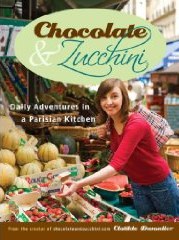
I've been reading Clotilde’s book
What most interests me about Chocolate and Zucchini, the pioneering food weblog, is the emphasis on how one might plan and think about cooking and eating. In one of the first posts I read, I remember that Clotilde had a bottle of wine she wanted to drink with her friends. “What will be nice with the wine?”, she asked. I’d always asked, “What wine would suit this dish?”
Tonight featured a good old-fashioned cooking disaster. These things happen. I wrapped a nice big chunk of my home-cured pancetta in a foil packet, and wanted to cook it gently, gently, in a very low oven for hours and hours. Because my big over would be busy, I used the toaster oven. Voila!
Except somehow the toaster oven’s rheostat founds its way to 400° (200°C) when I meant 200° (95°C). This meant the confit was way over. But it was mostly edible, and it certainly was as lean as pork belly can be!
- corn-chipotle muffins
- margaritas
- carpaccio of summer squash, goat cheese, cilantro sprigs, pear vinegar
- home-smoked duck breast, confit of pancetta-cured pork
- white Rueda
- asparagus and cod en papillote, with shallots, orange zest, dill, thyme, and crème fraîche
- duck stew (fresh figs and apricots, turnips and potatoes from the farm)
- a modest super Tuscan
- blueberry tarte with almond cream
- coffee and lemon sablés
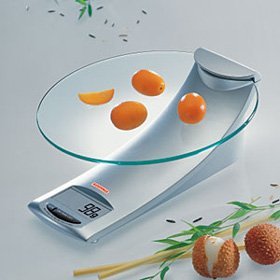
Making bread used to be a Big Deal that I did every year or two. Then I read Ratio.
First, get a digital scale. ($35 from amazon)
Put your bowl on the scale: press a button to zero it. Add 20 oz. of flour. (I throw in a cup of whole wheat; it makes Linda happier) No sifting, no fussing. Linda, watching me, said “You could maybe use just a little care when you measure!” But I don’t need to: the scale tells me when I’ve got 20 ounces.
Then, push the button again to zero the scale. Pour in 12 ounces of water. You don’t need to measure; I use a measuring cup for old time’s sake.
Then, throw in a couple of teaspoons of salt, a teaspoon of yeast. Or a whole packet of yeast — doesn’t matter. I squirt in some honey. Mix well. (Don’t break your wooden spoon, like I did; the splinters are nasty. Use the spoon until it gets too thick, then user your hands. Takes two minutes, tops.)
Let it rise for a while. Couple of hours? Sure. Last one, I let it go overnight and it was fine. Punch it down, form it into a ball, put it into an oiled dutch oven. Let it rise some more. Then pop it into a 450° oven — covered for 30 minutes, uncovered for 20 minutes. You’ve got a nice loaf of bread.
I improvised an interesting apricot sauce last night for Ruhlman’s Argentinian pan-roasted tenderloin.
Wash 4 apricots. Slice in half, discard the pits. Don’t worry about the skin.
Throw them in a small saucepan with a splash of olive oil, a small cup of white wine. a bay leaf, some thyme, some ground ancho (or cayenne, or whatever hot pepper you like), and a bit of honey. Cover, cook for about 20 minutes.
Drop in the blender. Puree. Back into the saucepan. Add a spoon of good mustard, a little salt maybe. My apricots weren’t very ripe, so I added a bit more honey. Heat. Serve.
It’s a nice color, and it’s rich and creamy without much fat.
Carol Blymire (the blogger behind Alinea At Home) went to Alinea last week and blogs the menu we enjoyed so well. Gotta love the enthusiasm:
It was the first time in my life I ever had a foie course that was light and airy and fragrant in this way. I could've eaten three of these. Or four. Or eleventy hundred kabillion frillion.
Blymire has recently been diagnosed with celiac, so she can’t eat wheat; when they came to the pigeonneau à la Saint-Clair, they’d simply planned ahead and made her crust with rice flour. That’s lovely. Think about it: the day before (or, perhaps, early that morning), they’d gone into the kitchen and started a special croustade specifically for her. Started two, I expect, because if you don’t have a spare, you’re gonna need it.
Ruhlman is ranting about paté a choux. This is a ten-pound name for a simple little concotion. You take some water — say 4oz. Add half as much (by weight) of butter. Heat it to boiling. Add some flour — the same amount, by weight, as the butter. Stir for a while until it's nicely mixed. Let it cool a bit, and then add eggs — one egg for every 2oz of water you added.
- 2 parts water
- 1 part butter
- 1 part flour
- 2 parts egg
Once everything was mixed, I added a half cup of grated cheese, spooned it onto a parchment-lined backing sheet, pressed a 3/8" cube of nicely crisped wild boar bacon into the middle, and baked them at 400•F for 10 minutes and 325• for another 15 minutes. Terrific. We had these with asparagus, steamed and topped with the rest of the grated cheese and then topped with one fried egg.
Kevin Eats ate at Alinea just a few days before we did, and offers wonderful descriptions and photography.
Near the end of the tour, our dinner at Alinea had a standard from Escoffier: pigeonneau a la Saint Clair. The course has been controversial; why include a staid 19th century showpiece in the middle of this wonderful postmodern feast? Achatz himself explains part of the point, but I think he is simplifying the thought.
What is this course saying?
First, what is pigeonneau a la Saint Clair?
With the meat of the legs prepare a mousseline forcemeat, and, with the latter, make some quenelles the size of small olives, and set them to poach. Poële the breasts, without coloration, on a thick litter of sliced onions, and keep them underdone. Add a little velouté to the onions; rub them through a tamis, and put the quenelles in this sauce.
In the middle of a shallow croustade, set a pyramid of cèpes tossed in butter, Raise the fillets; skin them, and set the on the cèpes; coat them with the prepared sauce; surround with a thread of meat glaze, and plant the quenelles all around.
OK: that’s the instructions. Why do we do this? It’s not just hoops to dance through, or an arbitrary set of rules or customs.
First: why pigeonneau – squab? At this point, we want some poultry to set off the steak and potatoes. Squab makes sense; we want a taste, not a turkey. This is a perfect time for a small bird: it’s a big menu.
But how do we approach the problem of cooking a whole bird perfectly, when the whole bird is so small? This is always the problem with poultry; the breasts are overcooked before the legs are done. Besides, legs are hard to carve, so squab is famously hard to eat. (The last time I had squab was at a wedding; that was just a little bit hostile!)
No problem: we’ll carve up the bird and prepare the parts separately in order to get each morsel right. We bone out the legs in the kitchen (where we have sharp tools and aprons), and mince them up to get rid of the toughness. We mix them with egg and cream to make an emulsion, and poach these little balls of squab sausage.
For the breasts, we want to season them gently and cook them very gently. If you have a great big chicken breast and the outside is just a little bit overdone for texture, it's no problem; make it a tiny squab breast, and a thin layer of overcooked meat adds up to the whole thing. So we cook it gently, gently, on a bed (a litter!) of onions. And then we mustn’t waste those lovely onions, bathed as they are in meaty juices, so we add a little bit more stock and turn them into a sauce. Add some mushrooms, since they go well with poultry. Serve in a shallow pastry bowl, which brings everything together, absorbs the delicious juices, and gives us another texture to experience and another place to vary the flavor.
So: it’s not arbitrary or fusty. It’s a solution to an old cooking problem.
It’s also a ridiculous amount of work. But we’re not being convenient here, we’re throwing everything to the winds to make the dish exactly right.
Now, lots of Alinea addresses the same sort of problem, using different means. Take that truffle explosion: a raviolo, topped with a slice of black truffle, and filled to bursting with black truffle juice. The idea is, simply, to have a burst of pure truffle flavor. But you can’t just do it, because you can’t fill ravioli with truffle juice, because the liquid will just run out on your counter. So we start working with gels and reductions, and we start reimagining tableware because we need to get that one perfect truffle raviolo to you without breakage or leakage and while it’s the perfect temperature.
This is a good way to cook a squab, just as the wagyu short ribs (perfectly rectangular, meltingly tender pieces of short rib on a Guinness gelatin sheet) are a perfect way to cook short ribs. The course is an argument that what Achatz does is not a repudiation of traditional cooking (as nouvelle was), but simply expands its horizons.
Twenty four hours later, I’m still assimilating impressions from dinner at Alinea. They remain less than coherent; in fact, it has been a dizzying experience. I’m going to start with incoherent notes and snippets; I’ll write about some of what seemed to me to be key ideas and key dishes once I’ve had a little more time to reflect. (Three days later: still dizzy — MB)
- This was the best meal I’ve ever had. (25th anniversary dinner; it ought to be the best.) All-time food list, barring things I've forgotten at the moment:
- Alinea
- the Thai fish lunch
- Les Bouquinistes III
- No. 9 Park
- Beach dinner, Rio Negro, near Manaus
- Topolobampo I
- Da Ilia, Milano
- Dorchester Grill New Year’s, London
- back room of some place, Firenze
- crawfish after the opera, Goteborg
- The Holiday Inn Fried Chicken Feast, somewhere in Alabama, c. 1962
- L'Espadon Bleu
- DOC bar
- Roman fish lunch (aka “my limoncello tree”)
- street souvlakia, somewhere in the Peloponnesus, 1964
- Geronimo, Santa Fe
- Amazing staff. Everyone busy, everyone working, nobody rushing, and nobody seeming to worry about their next task. This applies to both sides of the house (the magnificent, carpeted kitchen being partly visible from my chair) and despite adverse circumstances: I don’t know why a team of firemen with emergency gear appeared during dinner, or where they went, or what they did, but whatever went wrong, it was handled with calm and ease.
- Though I’d read a good deal about some of the signature dishes, each came as a delightful surprise. The truffle explosion was magnificent; for the first time, I think I understand the fuss about truffles. The frozen poached grape on the antenna sculpture — it works. The powdered essence of A-1 — it works. Many things that sound precious or silly when you read about them, actually work.
- The bread changes several times through the meal, often to play off a course. Two courses featured crab, duck confit, and peas; the bread was a cookie flavored with Old Bay. There was a wonderful little tea-infused bagel. There was a wonderful “plain dinner roll”, which just happened to be fresh from the oven – not, I think, reheated – at midnight.This is very well thought through, and now I wonder why more places don’t do more with bread. The ingredients aren’t costly, the work is mostly prep, little needs to be done at service, and if something goes wrong you know about it and can substitute.
- 25 courses is a lot. It was precisely the maximum amount of food I could enjoy. (A course per year is poetic, too.) Someone worked this out, with both hands. Everything has been worked out, with both hands, and without compromises.
- Magnificent wine, brilliant pairings. Takasago Ginga Shizuku Divine Droplets with the incredibly complex white asparagus and sorrel. The best pinot gris I’ve ever imagined, much less tasted, with crab and duck confit #1. (I can imagine good, but this is pinot gris, and this was good) The best spätlese I’ve ever had, with foie gras — an old spätlese, it was explained to us, so the sweetness folded in on itself. Face it: a wine pariting for “pork belly, iceberg, cucumber, and Thai distillation” is going to be a challenge. I didn’t follow every line of the proof, but I appreciate the moves.
- Late in the tour, pigeonneau a la Saint-Clair, right out of Escoffier, with a Chateaux Lascombes Margaux 2004. This course has been controversial. I think I understand part of its argument, and I’ll write about that later.
- Serving sweet potato pie on a cinnamon stick is clever. Serving it on a smoldering cinnamon stick is genius. Seriously. It sounds absurd, but it’s unforgettable. (And even more complex than it seemed)
- The informative, and helpful service avoids almost any talk about the wonderful ingredients or complex preparations. Just what a dish is, and (often) how best to approach it. More information on the wine, which makes sense, but even then, all that was said about the claret was “I’m not going to say much about this one.” Again, this is nicely thought through: if you know wine, you’re going to know about seconds crus bordeaux, and if you don’t, taste it: you don’t need the spiel.
by Michael Ruhlman
This book is important, not just because it will help you make dinner, but because it will help you understand dinner. We are emerging from the Bush era of mystical magical gibberish and have put upside-downism behind us. It’s no longer enough to do what we’re told. It’s no longer enough to believe that everything will be fine because we are Good People. It’s time for us to know what we’re doing.
Ruhlman argues that recipes are not enough; at best, having a recipe (and the necessary technique) lets you recreate a dish. You can cook it. If you like it, you can follow the instructions again. Instead, Ruhlman focuses on the key concepts that makes foods work; once you know these, you can make all sorts of things without fear.
Fear drives the cookbook business. The fear is: it won’t turn out. And, of course, if you just throw lots of stuff in a pot, like we used to do when we were six (and as clever as clever), it probably won’t turn out.
5 parts flour, 3 parts water: that’s bread. You need some yeast, but it doesn't really matter how much you add. You probably want some salt. You can add stuff: rosemary and caraway seeds, or almonds and raisins, or onion, or jalopeño peppers and dried tomatoes. You can change the shape. You can make a little, or a lot. Doesn’t matter. 5 parts flour, 3 parts water; it'll be bread.
I used to buy pancake mixes because it was so much bother to gather all the ingredients, measure them, and get the consistency right so the pancakes turned out. Sure, the Dancing Deer stuff it nice. But it’s not that hard. 2 flour:2 liquid:1 egg. An egg is 2 oz. So 6oz flour, 6oz milk, 1 egg. Throw in 1t of baking powder and 1/2t of baking soda. You can add some sugar if you like: maybe 3T. You can add some vanilla. You can add some blueberries. You can replace some of the milk with buttermilk or cottage cheese or sour cream. Want even fluffier pancakes? Separate the egg whites, whip them up, then add them to the rest. You can replace some of the flour with cornmeal or whole wheat or what you like. That's enough for 2. Need to cook for 8? 3c flour, 3c milk, 4 eggs.
It’s all like this. You can know this stuff. Nothing mystical, nothing magic, no weird rituals or procedures. Sometimes things don’t work. Ruhlman warns that mayonnaise smells fear. If your mayonnaise breaks, Ruhlman tells you how to whip it back into shape.
There’s lots of great stuff. How to make a great stock without making a big fuss. Or any fuss at all. How to whip up things like pie dough or cheese puffs off the top of your head. How to improvise a soup – any soup.
One missed opportunity is that paragon of fear, the souflée. Everyone knows that souflées are hard, dangerous, showy, and French. And Ruhlman has already covered the key ratio: bechamel for soups. The hidden trick about the souflée is: there is no trick. They’re like popovers: they just work. Alice Waters hits on this in The Art of Simple Food: the only thing that makes a souflée fall is cold air, and if your souflée does fall, pop it into a hot oven and it will poof again.
We’re seeing a second revolution in popular science in the US. The first was triggered by Sputnik, and led everyone to say, “the kids need science.” This time, in the wake of Bush and the Crash, we’re not leaving it to the kids. We want to know what we’re eating, we want to eat better, and we want to understand what we’re doing and why we’re doing it. Give us bread, and give us rosés.
by Michael Ruhlman

This book is important, not just because it will help you make dinner, but because it will help you understand dinner. We are emerging from the Bush era of mystical magical gibberish and have put upside-downism behind us. It’s no longer enough to do what we’re told. It’s no longer enough to believe that everything will be fine because we are Good People. It’s time for us to know what we’re doing.
Ruhlman argues that recipes are not enough; at best, having a recipe (and the necessary technique) lets you recreate a dish. You can cook it. If you like it, you can follow the instructions again. Instead, Ruhlman focuses on the key concepts that makes foods work; once you know these, you can make all sorts of things without fear.
Fear drives the cookbook business. The fear is: it won’t turn out. And, of course, if you just throw lots of stuff in a pot, like we used to do when we were six (and as clever as clever), it probably won’t turn out.
5 parts flour, 3 parts water: that’s bread. You need some yeast, but it doesn't really matter how much you add. You probably want some salt. You can add stuff: rosemary and caraway seeds, or almonds and raisins, or onion, or jalopeño peppers and dried tomatoes. You can change the shape. You can make a little, or a lot. Doesn’t matter. 5 parts flour, 3 parts water; it'll be bread.
I used to buy pancake mixes because it was so much bother to gather all the ingredients, measure them, and get the consistency right so the pancakes turned out. Sure, the Dancing Deer stuff it nice. But it’s not that hard. 2 flour:2 liquid:1 egg. An egg is 2 oz. So 4oz flour , 4oz milk, 1 egg. Throw in 1t of baking powder and 1/2t of baking soda. You can add some sugar if you like: maybe 2T. You can add some vanilla. You can add some blueberries. You can replace some of the milk with buttermilk or cottage cheese or sour cream. Want even fluffier pancakes? Separate the egg whites, whip them up, then add them to the rest. You can replace some of the flour with cornmeal or whole wheat or what you like. That's enough for 2. Need to cook for 8? 2c flour, 2c milk, 4 eggs.
It’s all like this. You can know this stuff. Nothing mystical, nothing magic, no weird rituals or procedures. Sometimes things don’t work. Ruhlman warns that mayonnaise smells fear. If your mayonnaise breaks, Ruhlman tells you how to whip it back into shape.
There’s lots of great stuff. How to make a great stock without making a big fuss. Or any fuss at all. How to whip up things like pie dough or cheese puffs off the top of your head. How to improvise a soup – any soup.
One missed opportunity is that paragon of fear, the souflée. Everyone knows that souflées are hard, dangerous, showy, and French. And Ruhlman has already covered the key ratio: bechamel for soups. The hidden trick about the souflée is: there is no trick. They’re like popovers: they just work. Alice Waters hits on this in The Art of Simple Food: the only thing that makes a souflée fall is cold air, and if your souflée does fall, pop it into a hot oven and it will poof again.
We’re seeing a second revolution in popular science in the US. The first was triggered by Sputnik, and led everyone to say, “the kids need science.” This time, in the wake of Bush and the Crash, we’re not leaving it to the kids. We want to know what we’re eating, we want to eat better, and we want to understand what we’re doing and why we’re doing it. Give us bread, and give us rosés.
by Claudia Roden
“What can I bring?” I ask.
“Why don’t you make some gefilte fish? Maybe with salmon?”
This became a mission. I searched high and low. I watched YouTube videos of restauranteurs making special gefilte fish. I read books. (No one who reads this page regularly will be surprised that I bought books, too.) I corresponded with cooks on three separate continents.
In the end, I made a pretty straight gefilte fish, right out of Roden. I used 2/3 fresh salmon – the Cambridge Museum Of Fruits and Vegetables threw a sale on wild coho just for me – and 1/3 hot-smoked salmon; the smoked salmon was suggested by Michael Ruhlman himself. (There's a nifty salmon rillettes in his Bouchon book, which was impossible here but I'm going to try it right away.) I stayed fairly close to Roden’s recipe, using less sugar.
I poached the little gefilte fish balls in fennel broth. For garnish, I found some terrific little spring carrots, which I pickled overnight in dill brine, and I made some aioli for a condiment. Linda hates beets but something like chrain, the traditional beet-horseradish sauce, seemed like a nice idea. So, I whipped up some roasted red peppers with grated horseradish.
Pickled carrots
- 1 bunch of really good young carrots, preferably with greens
- 1 small bunch of dill
- salt
- water
Cut off all but 1" of the carrot greens. Wash, or lightly peel the carrots. Don't overdue it.
Make a 20:1 brine. 4C of water, 50g=2oz (by weight) of salt. If you don’t have a scale, say 4T salt. This is not rocket science. Add a few peppercorns if they're handy. Bring to a boil; let the salt dissolve. Put the carrots in a glass baking dish, pour the brine over them, add the dill. Let them cool, refrigerate. 24hr later, they’re pickled carrots. Who knew?
Fennel broth
- 2 large bulbs fennel, coarsely chopped
- 4 shallots, sliced
- 4 cloves garlic, sliced
- 2 allspice berries
- 1t whole peppercorns, crushed
- 1T sugar
- a little salt
- 4c water
Cover, heat to near boiling, then simmer gently for perhaps 45 minutes.
- 1.5lb fresh salmon, cut into 1" chunks (keep cold)
- .5lb smoked salmon (hot-smoked and chunky smoked salmon is fine), cut into 1" chunks (keep cold)
- 1 medium onion, cut into large chunks
- 2 eggs, separated
Spin the onion in the food processor until coarsely chopped. Add the salmon, and spin until it, too, is coarsely chopped. Add the egg yolk, spin to combine everything. You don't want to purée. You just want to get rid of all the large chunks; if you chop too much, the fish will by unpleasantly pasty.
Whip the egg whites to soft peaks. Fold about 1/3 of the fish into the egg whites, then add the mixture to the rest of the fish. Fold until mixed. Refrigerate for 30 minutes to let everything rest.
Put the strained fennel broth in a pan (I used a sautoire, but any deepish skillet or saucepan will do), and heat to a bare simmer. Taste it; it should taste good. Add some salt if needed.
Take the fish, shape it into golf balls, and drop into the simmering broth. Cook for about 6 minutes, in batches. Fish them out with a slotted spoon. Strain the broth, cool it a little (throw in a couple of ice cubes if you like), and our some over the fish. Refrigerate overnight, and serve cool with aioli (crush a couple of cloves of garlic to a paste with salt, add to bowl, squeeze 1/2 lemon into it, add an egg yolk, gradually whisk in 1C of olive oil).
Linda’s Russian History course runs late on Wednesdays, giving us an occasion for an interestingly late dinner. The starting point for last night’s treat was a pair of very nice chops of a Tamworth pig that Savenor’s had for sale. I’ve never cooked a lot of pork – I don’t think I've made pork chops in a decade – but I keep reading about the wonders of good heritage pork. So, I grabbed them, and took advice from Pork & Sons.
What I ended up doing was simply salting and peppering the chops. I brushed them lightly with olive oil, and let the sit for about 45 minutes. While they sat, I cooked some macaroni, and then cooked it again in milk thickened with blonde roux. The macaroni went into a gratin dish, was topped with a big handful of grated gruyere, and baked for 20 minutes.
While the macroni baked, I warmed up the grill. Linda came home. I opened the wine (a Touraine gamay – not an inspired choice). I grilled the pork chops, and let them rest. I took a St. Marcellin cheese out of its cute little ramekin, cut it in half, and dropped a piece on each pork chop. Then, quickly run the pork chops and the macaroni and cheese under the broiler for a couple of minutes, pop them onto nice warm plates, and enjoy.
Oh, and we had Michael Ruhlman’s neighbor’s lemon bars for dessert!
I have an egg poacher. You know what I mean: four little teflon-coated cups, each the size of an egg, that sit over a pan of hot water. Maybe your poacher has six. Doesn't matter.
I’m not wild about poached eggs, anyway.
But this morning the cupboard was somewhat bare, and yesterday was pancakes, and so I thought maybe I’d make hash browns. But hash browns all by themselves seem wrong, somehow. I was thinking of a nice plate of hash browns with a fried egg on top. But Linda doesn't like fried eggs, and it did seem like there was a lot of frying going on anyway. So, poached eggs. Big hit. Yum.
Here's the question: should the water in the poacher:
a) sit below the level of the little holes in the cups, so the eggs steam?
b) sit exactly at the level of the little holes in the cups?
c) sit a little above the level of the little holes in the cups? (If so, should it be salted?)
Now, the ur-poached egg was made in a pot of water, so in principle a little water doesn't hurt. But which of the above is ideal? (Or is this one of the Eternal Questions to which only George Burns knows the answer?)
Meanwhile, dinner is a lovely prime chuck roast, with potatoes, mushrooms, carrots, celery, and a nice red Douro.
Tonight’s dinner was Boston Butt, braised in dark beer with garlic, shallots and bacon, served over home-made spätzle. I'd planned to bail out on the spätlzle and make some pasta — the Pork & Sons recipe gives you absolution in advance — but then I thought, “why not?”
And it turns out spätzle are incredibly easy. Flour, eggs, salt. Maybe a little water if needed. Slice or extrude into boiling water (I used a potato ricer), cook for a couple of minutes, dry on parchement. Just for fun, I sauteed them in a little butter before adding pork and tasty broth.
For dessert: tarte tatin. For wine: Home Grown Red, an inexpensive California blend said to contain barbera, petite sirah, and shiraz.
A cup of flour, a half teaspoon of salt, two eggs, and 12 ounces of milk. Mix, pop into the popover pan, pop into a very hot oven. Wait about half an hour. Take them out, enjoy them with real maple syrup.
Yes, get the real stuff. There’s a drought in Canada, so it costs more right now. Hint: lower-grade maple syrup is good — it just looks dark. Always better than imitation.
“You cook every night,” Meryl reminds me. “I cook every month.” Nonetheless, Meryl’s going to join us to take a quarter-share in our winter meat CSA. It’s a new experiment — just a dozen people, six months, ten pounds of meat a month. One month mostly lamb, the rest mostly beef. All organic, hand-raised, grass-fed, from the same farm that grows our summer vegetables.
I’m incredibly ignorant of butchering, but as far as I can work my sums, we’re talking about everyone sharing one cow and one or two sheep, right? So, this winter we’re going to be eating Twinkles and Herbert?
I’ve always wondered how the farm kids who did things like 4H dealt with this. But mine is a shabby, second-rate attitude: you ought to understand what you eat. Bob Del Grosso has been writing a lot about this lately, and writing very well indeed.
We did not receive whole animals larger than lambs at Rene Chardin Restaurant, neither did we butcher and cook any animal while we listened to it's mother calling for it as I did last week.
Yeah, you read that right. Hearing that cow calling to it's calf as it lay on the table in my kitchen being cut up was sobering. Anyway...
I'm learning more about cooking in this job than I ever thought possible. I've got this whole other set of considerations regarding the ethical nature of what we chefs do staring me right in the face every day. It has not made my work any harder, but it sure as hell has made it different.
A writer I know recently twittered that she’d tried to make a big batch potato-leek soup, that it had turned out way to peppery even though she’d followed the recipe, and what could she do?
Fixing recipes is always interesting.
First, you can start over. This costs you style points — it’s literally unprofessional. But we’re not professional cooks, we’re just making dinner. Sometimes, you chalk it up to experience.
One of the best parts of Alice Water’s Simple Cooking is a list of pantry dinners — good dinners you can improvise from staples you’ve got lying around. The unsalvageable goof is the perfect time to hit the pantry. Spaghetti Alfredo, or a nice carbonara with whatever greens come to hand, or a gratin of potatoes and whatever else you've got handy will cover a host of ills.
Second, you can often double down, diluting your mistake by mixing it with another batch. A little too much salt in the soup? Make another batch of soup, don't salt it at all, and then add the salty soup gradually until it’s just right. (This won’t work very well, however, if you’ve added the wrong thing entirely. If you meant to reach for the apple cider and got cider vinegar instead and it tastes terrible, diluting it will just give you soup that tastes kinda terrible. Same for burnt: you can take things surprisingly far once you learn about deglazing the pan, but if it tastes like charcoal, you’re doomed.)
Third, treat the mistake as a product and use the flaw as a strength. Your soup has lots of nice leeks and potatoes and cream, but way too much pepper? There’s a whole family of recipes for things like “chicken casserole” which call for a can of cream soup. (Classically, they call for chicken velouté or béchamel, but your mom used Campbell’s Cream Of Mushroom. Listen to Mom. After all, who added all that pepper?) You make the same thing, but instead of canned soup you’re going to use a wonderful home-made stock that just happens to have been pre-seasoned. You’d be adding a lot of salt and pepper anyway; just add less pepper.

In The Emerging Democratic Majority
This is important to American politics, and it explains one of the vast (if quiet) changes we’ve seen recently. Suburbs used to be Republican strongholds, red rings that surrounded blue cities. It’s not true anymore, because the suburbs are filled with new professionals, often following new professions. Computer programmers, tech writers, industrial designers, analysts, artists, actors, architects, Web developers. They've all got something in common.
But what, exactly? The old answer was, they all had jobs where they could keep their hands clean all day. But that’s not quite right, and it doesn’t explain why they’re progressives. Another old answer was that they were independent, either self-employed or able to switch jobs whenever they felt like it. But that’s not right either — and it’s not really true anymore.
Teixeira and Judis offer an intriguing new definition: to them, “professionals” are people who are chiefly motivated to create great things or great ideas. This contrasts to the assembly-line worker, motivated to get the best deal in exchanging time for money. It contrasts, too, with managers and entrepreneurs who are motivated chiefly by performance.
It’s a handy division. Michael Ruhlman, for example, has often explored the question: “Is cooking an art? Is a chef a craftsman, a business executive, a performer, or a salesman?” Obviously, all are true some of the time, for some people. The Teixeira/Judis definition is really handy here: the line between chef-professional and chef-manager is the line between cook and shoemaker, the line between the obsessive (It’s not right; do it over. The patron will wait.) and the pragmatist (time’s up, good enough, get it out of my face).
After a tricky day of family web design and home sysadmin, I wanted to keep dinner fast and simple. Fortunately, I had a skirt steak that I'd been marinating. So, dinner was no production:
- grilled skirt steak (rubbed with a paste of minced garlic, ancho powder, brown sugar, cider vinegar and marinated overnight)
- burnt vidalia onion and fresh cilantro relish (salt, pepper, sugar, wine vinegar)
- Clotidle's homemade pistachio gelato (substituting cream for mile and 1T brown sugar for the agave (!) syrup)
The gelato is a nice example of a cooking principle: if you don 't have the equipment, just do it. I don't have an ice cream maker. Did that stop me? No! I just mixed the ingredients, cooled them on the counter, stirred them, cooled them more in the freezer, stirring occasionally. By dinner, the cream was nice and thick and cold.
Next time, I'll cut back a little on the limoncello, and perhaps I'd serve this with a bit of crunchy pastry or maybe candied nuts and orange zest.
I'm going to have a weekend in Paris in September, in transit after WikiSym. Oh, the possibilities! I'm tempted to plan nearly every meal. This is madness.
But what do you think? Email me.
At Salon, they've lined up an entire week of essays on pork. Pork week. Wow.
On Day Two, Rebecca Traister reflects on why she cures her own bacon.
Well, to be fair, it's really my boyfriend, into whose apartment I have recently moved, who cures his own meats. His interest in this enterprise developed in the late fall, soon after I met him. Before me, there had also been an extensive flirtation with duck confit, a dalliance that explains the surprising number of duck carcasses in our freezer.
I like her boyfriend.
I fell for a guy who, when he says he's going to make soup, takes out one of the 12 kinds of homemade stock he has frozen, and when he says he's going to make burgers, starts considering what kind of bun he'll bake for them.
I love the idea that there's an site where you can find a perfect match with a farmer who will have a particular breed of pig on a particular day. “When you hold an animal's insides in your hands, big and fresh and smelling of nothing but flesh and fat, you feel a certain responsibility to put them to good use.”
Still too early for corn, but not too soon for serious grilling!
- cedar planked salmon (marinated in dill, herbs de Provence, lime, and white wine)
- barbecued baby-back ribs (marinated 150 min in brown sugar, extra cayenne, cloves, garlic, allspice, soy sauce; roasted in foil for 90 minutes; cooled, grilled 30 min over hickory while basting with the boiled marinade)
- red cabbage, onion, peanuts
- deer-tongue lettuce salad
- raspberry fool
- a chilled bottled of Wrongo Dongo (a Spanish red, and very nice too once it had time to breathe)
After the wonderful fish at a Chalandra — tiny clams in broth, a rich portuguese fish soup freshly made for us, a lovely (though surprisingly costly) grilled snapper, and a positively medieval pudding — we returned to the hotel to find great crowds gathered in the square, singing traditional songs (in harmony) and parading in mock-traditional workers' garb. Wine growers gathering grapes, bakers and their bread trays, sailors and their wenches — all singing and dancing and flirting with friends in the crowd or playing with the six-year-olds (or the sixty-year-olds) in costume parading with them.
A very impressive dinner for the program committee at Sessenta Setenta (60/70, a pun on "sit and try"). I had a tasty ceviche with a very nice vinho verde, and then a beautifully roasted rack of borrego with a lovely red blend, and then a plate of fresh cheese with a honeyed fig, a bit of honey, and a glass of vintage (!) port.
Why do we indulge in this sybaritic luxury? Of course, it's nice to thank busy scholars and scientists for taking time to read so many papers. Some of us have read twenty, and then sorted through other reviews and discussed the paper in depth with colleagues, and now of course we're about to look at every paper again. And then, of course, the inconvenience of travel is significant; I happen to like to travel, but not everyone does. And even for me, spending a long night in a middle seat, next to an infant who has boundary issues and likes to kick — well, you can imagine.
But, aside from that — and beyond the social lubrication that sharing a meal or two lends to the ideological and methodological disputes we are going to need to address to arrive at a program — conferences are held in specific places. And, if we’re going to travel to these places with our colleagues, we really ought to pay attention to their particularity. We may be coming to Porto, basically, because this is where Professor Aguiar happens to teach. But because Professor Aguiar teaches here, not Barcelona or Berlin or Bangkok or Biloxi, the wiki world is heading for Porto this September. It behooves us to experience and enjoy Porto while we're here.
Besides, the wine is really good, and the sommelier has a farm nearby and will be bottling his sparkling wine in September, and he invites us to drop in when we're in the neighborhood.
I'm chairing a meeting for WikiSym in Porto on Saturday. I'm here on Thursday, so that a plane cancellation won’t leave my meeting unchaired.
But no time or resources are wasted; the early arrivals are sampling food, tasting drinks, and discussing many esoteric topics to make sure that WikiSym will be everything it can be.
Much depends on dinner. It always does. If you think Google makes you stupid, try skipping a few meals while flying across an ocean.
For dinner, we had veal transmontane (very tasty — we kept calling it lamb— with kale and new potatoes and olive oil) and fluffy fresh cod (more new potatoes). A glass of white port with the charcuterie, and a bottle of vinho verde with dinner. After dinner we checked out a drinking establishment where we might take the conference after the banquet. Research continues: is the local beer OK? What is the aguardiente that the characters in my Portuguese mystery keep drinking? (It's distilled, it's somehwere between brandy and grappa I think, and the top-shelf brand I sampled was very good indeed) What will the band be playing? (Several amplified traditional fretted strings, from lute to bouzouki, and two kinds of bagpipes, and a front singer) What happens if it rains? How will people get there, and how will they find their hotels?
update: the link below to "Mader on WikiSym" was suggested by Tinderbox and its link apprentice. Tinderbox suggested this before I mentioned that Mader was at the dinner; he ordered the codfish. Sometimes, the link apprentice is too smart for its own good.
Harold McGee has a blog, and explains why white pepper sometimes develops nasty flavors. Short version: they ferment away the fruit and keep the seed, and when you ferment barrels of fruit outdoors in the tropics, sometimes things get out of hand.
Eric Ripert, simultaneously, blogs about why he likes white pepper. Meanwhile, Ruhlman's reminding us that chilli peppers are spelled with a double 'l' (a borrowing from Nahuatl.
by Alice Waters

I fancy that, in the introduction to this inviting volume, we hear an echo of Isak Dinesen's "I had a farm in Africa."
My delicious revolution began when, young and naïve, I started a restaurant and went looking for good-tasting food to cook.
The restaurant was Chez Panisse in Berkeley, the year was 1971, and the revolution was complex. The first part is now well known: Waters found that she couldn't buy the ingredients she wanted and, unlike American chefs before her, she wouldn't make do with substitutes or imports but built a network of growers who cultivated produce and raised meat specifically for her. Nor was she content with simply getting great ingredients to her restaurant: she lobbied everyone else in sight to do the same thing, and to patronize the same growers, and so the growers made more money and their neighbors began to emulate them. Out of her kitchen, she set up a series of former employees as bakers and suppliers. And, while she was at it, she made her kitchen the training-ground for a generation of American chefs and restauranteurs, many of them pioneering female chefs, and they went on to transform the industry Unless you know the story, that line about "my delicious revolution" could get lost.
This manifesto masquerades as a recipe book in two sections. First, we have about 30 pages of introductory essays: what to have in your pantry, what to keep in your kitchen drawer, what to cook. These essays are lively and engaging reading for any cook, and they can open your eyes. Waters is the Prophet Of Fresh, but after explaining what staples you absolutely need in your pantry (garlic, onions, shallots, celetery, carrots...), she takes time out to list about fifty dishes you can make using nothing but the stuff you have in your pantry — dishes you can make for dinner when you just couldn't manage to get to the store. It's terrific to be reminded of what you can do when you have nothing to cook tonight: whip up some carrot soup, a cheese souflée, roast shallots, and finish with lemon curd or butter cookies, and who would know that you couldn't be bothered to shop?
The second section of the book discusses "foundation" recipes, exploring food groups and styles through a few exemplary recipes. We start, characteristically, with salads: how do we make a decent salad? The breads, broths, beans, pasta, and on to baking, satueeing, braising, poaching, and grilling. The book then concludes with hundred and fifty pages of recipes that can be treated more concisely because the foundations have been covered.
This volume, then, is a mirror to the new Ruhlman: where The Elements of Cooking supplements some essays with a glossary, The Art of Simple Food supplements some essays with a recipe book. In both cases, the author (or their editors?) are trying to hide those unpopular, unsalable essays in a more palatable and familiar melange. In both cases, I think, the essays are by far the strongest point. The foundational arguments can be done as well by Sally Schneider (The Improvisational Cook
I've had my eyes on this Rick Bayless recipe
But this turns out to be really easy, and good.
We begin with an tinfoil roasting pan that we're going to nestle between the coals of our Weber grill. But, instead of using it just to catch and discard grease, we fill it with three very nice carrots (diced), a biggish white onion (small diced), a few Yukon gold potatoes (large diced), , about ten cloves of garlic (peeled) and about a quart of water.
Over this bowl of soup-to-be perches a lamb shoulder roast. Salt it really well before it goes on the grill. At either side we have hot coals, and some soaked hickory chunks. The whole thing is covered and the fire is kept on the low side of moderate, and it all goes for a couple of hours. My fire was excessively moderate, and so it was like three hours. You're taking the lamb shoulder all the way to well done -- 170°F or so. From time to time, add water to the pan, and add coals to the fire.
When the lamb is done, you take it off the grill and let it rest for twenty minutes. Then you pour the soup and vegetables into a pot, rush it into the kitchen, separate out the fat (there is less than you'd think), add about 3/4T of salt, one minced chipotle, and a handful of chopped cilantro.
And so you can sit around the fire and sip cups of this really tasty, smoky soup, eat hunks of this tasty roasted lamb (I made a bowl of tomatillo-chipotle salsa which played the role normally played by barbecue sauce), and drink lots of beet.
I saw a sign at the grocery. They had a lot of frisée. They wanted to sell it.
So they suggested sweating some shallots in butter, and then wilting the frisée. Drizzle with cream, grind a little white pepper. Serve with surprisingly inexpensive bay scallops. Nice.
I've never cooked frisée before. How long has this been going on?
First grilling opportunity of Spring!
- grilled striped bass with crême fraiche, mustard, and dill sauce
- smoked brisket of beef
- corn on the cob (surprisingly good corn, too)
- raspberry/blackberry slump
I can't quite get the knack of fileting the bass for service, and this time I wound up with several unsightly piles of meat, skin, and bones. It's tasty fish, and a nice sauce, and I did get most of the bones. But plenty got through.
The fire, slow to get started, ran away with me; I wanted to take the brisket off at 190° and it got to 210°. But all was not entirely lost; the crust was black but still tasty, and the meat remained quite pleasant.
I need to remember how easy it is to make Megnut's slump. It is, literally, about five minutes prep for the crust. Much easier than pie.
Hervé This lists the ten elements of basic kitchen knowledge.
- Salt dissolves in water.
- Salt does not dissolve in oil.
- Oil does not dissolve in water.
- Water boils at 100 C (212 F).
- Generally foods contain mostly water (or another fluid).
- Foods without water or fluid are tough.
- Some proteins (in eggs, meat, fish) coagulate.
- Collagen dissolves in water at temperatures higher than 55 C (131 F).
- Dishes are dispersed systems (combinations of gas, liquid or solid ingredients transformed by cooking).
- Some chemical processes - such as the Maillard Reaction (browning or caramelizing) - generate new flavors.
This is a fine, thoughtful list. It's not complete. One of the most important missing elements is:
3a. Some flavorful components — notably some flavors in onions and herbs — dissolve in oil but not in water.
Also, while salt is central, I think it is worth mentioning that sugars and acids generally don't dissolve in oil and do dissolve in water.
Thanks, Michael Ruhlman!
While in Chicago, we had a lovely dinner at Avec. It's an unusual restaurant, but I think it's not going to be unusual much longer.
Avec is squeezed into a long, narrow space. It's an adjunct to Blackbird, a more conventional (but much lauded) restaurant. This happens all the time in Europe, where you can find great kitchens that have a few extra, informal tables in a space next door. But Blackbird is already long and narrow, so Avec has to cope with a space big enough for a very long bar and one long row of communal tables.
No reservations; you get seated when there's space. Informal (but attentive) service. Serious food.
We had a fine plate of charcuterie, followed by a lovely homemade duck sausage with roasted mushrooms, pickled onion, and tasty, flavorful spheres of what I thought were pasta (or tapioca) but were actually giant couscous.
And then we had chorizo-stuffed dates, wrapped in very thin slices of bacon and sauced with piquillo peppers and tomatoes, These were seriously good! It's not overly elaborate; you need the smoky bacon to balance the date, you need the date to offset the spicy chorizo, and the sauce helps heighten everything. So no wasted moves, but it makes a very tasty plate.
And then we had a piece of pork shoulder, brought to the table in its own little Staub coccotte, braised with stock, dried apricot, slab bacon, and apricot mustard. Brilliant!
Finishing up with cheeses was, so to speak, icing on the cake.
I see several interesting trends converging here:
- Eating at the counter, or near the counter
- Attentive but simple presentation
- Serious food, convivial lunch-counter style
- Communal or ad hoc seating
Some old Boston restaurants had long communal tables. Legal Seafoods, when it was a neighborhood dive, did this. So did Durgin Park before it was purely touristic; maybe they still do. But Australian restaurants seem to do this a lot. And while Paris bistros give you your own table, a crowded bistro gets pretty communal. This might not be quite the thing for the proverbial Big Night Out, but it can also be good fun. (I expect it only works for restaurants too expensive for small children to be very common.)
Late at night, my sister went outside her hotel for a smoke and struck up a conversation with another guest, whom she describes as immense, young, and very good looking. After a bit, he looked at her and said,
I bet you have no idea who I am!
And she didn't. OK, this is my sister, the girl who was told in a restaurant that they needed her table and replied with some irritation. "And who the hell are you?"
"I'm Bill Gates," he explained.
"And who is Bill Gates?" So Jan wound up having dessert with BillG@microsoft.
Jan asked the atheletic fellow who he was, but he told her that he likes it when people don't know. And so we don't.
When grilling, we sometimes have margaritas.
I have learned, by the way, that the secret to a really good margarita is good tequila. That's surprising, because a really good margarita has a lot of fresh lime juice, and you'd expect the lime juice to overwhelm the nuances of the liquor. No dice: I tried upgrading the tequila just once on a lark, and now our margaritas require a small bank loan.
But they're good.
I mention the margaritas because, when we have margaritas on the porch, it always brings out the garden slugs. They love margaritas. They even climb stairs.
Cathy Marshall just discovered that her houseplants are even better than margaritas; her slugs climb up to the roof! And they're not very well brought up:
I realize that slugs don’t bite, don’t sting, and they’re a great deal smaller than I am. They’re not that menacing. I was in no particular danger. But—ewwwww—they’re gross. Snails at least have the great good sense to wear some kind of outer garments.
We had Linda's late birthday dinner at Toplolobampo last week, as we were in Chicago for my mother's 80th. I had the mole tasting menu, which is inspired by the writings of Martha Chapa. I don't know Martha Chapa; I should. These days, menus come with footnotes.
The appetizer was a very pretty dish of two square blocks of fire-roasted poblano, serving as bookends for a 45-minute egg. As I understand it, the egg is some sort of sous vide preparation; it was a nice egg, but I'm not entirely sure what I was looking for. It was all nestled in mashed peas, which make a handy springtime sauce.
The soup was oxtail, from happy, educated oxen who had been fed tall grass. Tall grass must be handy, if you are of the bovine ilk. The soup had grilled ramps and xoconostle jellies. Xoconostle is a cactus; I bet you knew that. All the foodies love ramps, especially grilled. I like them a lot, too.
The squab came with "Guanajuato-style mole Francachela". You not only need footnotes, you need a scorecard. (At the time, I was busy enjoying the tasty poultry in its complex sauce. But you could have looked it up. I did later. No dice: I guess I need a Mexican Larousse. Or Ms. Chapa!)
The star course was a delicious piece of roasted goat, with a remarkable hot and sweet mole with ancho, pasilla, guajillo, almonds, raisins, pecans, sesame, chocolate, and more. The dessert (tres leches cake) had just a touch of ancho and pasilla too.
With everyone talking about the glories of veal stock, I realized my reserves of stock were just about exhausted. And so, with 7 pounds of really nice veal bones from Savenor's, I embarked on a stock weekend.
You don't have to make a big tsimmes, as Ruhlman recently reminded us. Grab 3 lb of bones, roast them if feel inclined, toss them in a pot, fill it with water, and leave it uncovered in a 180° oven for a few hours, Easy as pie. You can add mirepoix, you can add a sachet, you can do all sorts of stuff. You don't have to. Nobody will take off points.
Innovations this time: the pot was uncovered throughout, and I let it simmer a little more aggressively than usual. I also let it go for five hours before adding the mirepoix (roasted onion, carrot, and celery) and tomato, where previously these went in from the start.
I borrowed two ladles of veal stock for dinner, to make a nice mushroom sauce for the roast chicken. Hot pan, olive oil, shallots. Mushrooms. Deglaze the roasting pane with the veal stock; add to the mushrooms, reduce. Serve.
- Roast chicken with mushroom sauce
- Oven-roasted asparagus
- Chocolate bread pudding with bourbon sauce
The entree made a really nice plate.
The bread pudding, incidentally, was a big win, and easier than pie. Whole wheat supermarket bread, 6 oz. of really good bittersweet chocolate, some cream and sugar, a couple of eggs and an egg yolk. The dessert sauce is butter, sugar, whiskey, and nutmeg; simmer until dissolved, then whisk in a beaten egg and simmer 'til thick.)
The only bad news is that, after the sauce tonight, I only managed 32oz of stock. Ouch. But there's still the remouillage tommorrow.
Day two: take the bones and vegetables from yesterday's stock out of the refrigerator, fill the pot with cold water, and do it all over again.
I've never tried remouillage like this before; it sounded like cheese paring. But the ten hours of simmering on Saturday left me just 32oz of stock — very strong, rich, gelatinous stock to be sure, but it's still just four cups. So, once more into the breach.
And it worked nicely; nothing more added, and it still came out rich and flavorful. I took 3 or 4c for dinner and still had a quart and a half to freeze
- watercress soup, with toasts and gentleman's relish
- red snapper, poached with onions, mushrooms, and garlic
- leftover chocolate bread pudding with southern whiskey sauce
This was also my first encounter with the Super 88 fish counter, which looks very promising. Many tanks of live fish, and lots of fresh fish I've never tried.
Last week, I roasted a whole leg of lamb. It was on sale at the store, I needed to cook something, and I wanted leftovers. It was good. So were the leftovers. But there was still a lot of lamb left over, and my steady lunch slate of roast lamb sandwiches is not making inroads.
So, I took the remaining 1,5 lb. of meat and chopped it into bite-size chunks and put those in a large sautée pan with just a little oil. While they gradually heated, I roasted 6 cloves of garlic in a hot dry skillet for 15 minutes, and toasted four largish dried pasillas (stemmed and seeded) for maybe 20 seconds a side in the same pan. The pasillas went into some water for a 30-minute soak, and the garlic cooled and waited to be peeled.
Then, I threw the peppers, the garlic, and about 1/2c of the soaking liquid into the blender with some pepper and cumin seed. Much whirling, then straining. The sauce goes onto the lamb. I wanted 2c of stock to add to the lamb at this point, but (shame!) I'm out of stock. "Water will do!" says Michael Ruhlman. So water it was, and it did fine. Also throw in a peeled, cubed sweet potato. Simmer for about 40 minutes.
If you were starting from raw lamb pieces, I'd just brown them well before adding the sauce, and simmer an extra 30 minutes or so before adding the sweet potato.
Then, add some honey. About 1/4c, maybe a bit more. Mix well. You want it to be sweet, but just barely sweet. Give it another stir, toss in some fresh cilantro, and make tacos with the lamb, some home-made guacamole (since a container of guacamole at the museum of fruits and vegetables was $11!), some sour cream, and some raw onion. Very nice with a Magic Hat #9!
It's an interesting dish (adapted from Bayless): distant memories of the Alhambra with a strong Indian accent.
- tart with spring onions, applewood smoked bacon, sheep's milk cheese, and ricotta, on puff pastry
- homemade onion soup, with surprising quantities of onion sweated for 2.5 hours, then cararelized and deglazed four times with water and twice with sherry.
- braised short ribs of beef
- homemade clementine ice
- chocolate tart with pecans
The tart is a bit fussy but it's a keeper. The jury is still out on the onion soup, which really needs to be great since it (a) consumes 6 cups of precious homemade stock and (b) all that sweating and caramelizing and deglazing is a lot of trouble, Mrs. Pedicaris. I thought it was underseasoned the first time, Linda thought it was salty, and I'm having a tough time with my croutons. But it was oniony, anyway.
The homemade ice (juice, a little syrup, tossed in the freezer and stirrer occasionally) is a win. It's a nice idea from Alice Water's nice new book about The Art of Simple Food
A previous flirtation with duck ham had gone astray. It tasted just like ham, so what's the point?
Last night, I wanted to build out my duck confit a bit. So, I made a bed of mesclun drizzled with a little sherry vinegar, and placed a nice, hot and crisp piece of confit on top. Two small pear slices along side, and three slices of duck pastrami. (Two duck breasts, cured in sugar, brine and pink salt for 36 hours, coated in toasted black pepper and coriander seed ground coarse, and then smoked for about 2 hours over pecan)
- salad of duck confit, duck pastrami, mesclun and pear
- hanger steak, carmelized onions, mushrooms
- grilled baby artichokes, balsamic peppers
- pecan pie
Aside from the confit, an all-American meal. (You could quibble about the artichokes, but the peppers are pretty much a 19th century relish.)
Last night after work, I had a small problem. Earlier in the week, I'd stopped by the wine store, and they were tasting this interesting white Bordeaux (Chateaux Villa Bel-Air Graves 2002) that has tons of oak and malolactic fermentation and was only $12. So I grabbed some.
This wine may be impeccably French, but it could drop by Veronica Mars' for lunch with the girls and nobody would know that it was an exchange student. But what do I know?
Except when I got to the cash register, the wine actually was $21. Oh well. I got a couple of bottles anyway. We'd had half a bottle on Wednesday, so I wanted to cook something that would go well with the remaining half.
Also, since preparations for CAQDAS and Tinderbox Weekend UK are in full swing, it was already late. So I needed something that was fast, easy, could be made with ingredients on hand.
- Preheat oven to 350°F. Lightly butter a baking disk.
- Strew the baking disk with a diced shallot.
- Slice mushrooms to cover the shallots. (Next time, I might dice them for a quick and dirty duxelles. But slicing is fine). Don't skimp; plenty of mushrooms.
- Split a banana. Lay bananas across the mushrooms.
- Layer some fish filets on the bananas. (I used tilapia)
- Split a vanilla bean, scrap out the seeds with a sharp knife, and rub on the fish. Then sliver the beans and nestle amongst the mushrooms.
- Add a little wine. I didn't want to use that lovely Graves for cooking, so I grabbed 1/4c of madiera and a little vermouth. Season the fish with salt and pepper.
- Cover with some lightly-buttered parchement. Bake for 20-25 minutes. Serve. (I reduced the sauce first, but you don't have to)
You say, “Banana?” I got the idea from the cook on the Amazon trip, who used either banana or plantain in a fish braise. Which? Couldn't find out. I tried banana, since it was handy; if the answer was really “plantain”, I figured the banana would tell me. It held up surprisingly well to 25 minutes in the oven; when finished, it was sweet and roasted and savory but not mushy.
You say, “Vanilla?” That idea came from Catalina, in Sydney. But it coordinates with the Amazon spirit of the thing.
What was missing? It needs a chewy green. Maybe kale? Or baby bok choi? But good!
I stopped in Savenor's to get a chicken. Lately, Michael Ruhlman has convinced me that roast chicken needs to be brined, and that’s enough of a production that I’d rather get a really good chicken.
So I pulled into the 15-minute parking space in front, and left with a chicken, two huge lamb shanks, an artisan sausage, and a hanger steak.
As I handed over the contents of my wallet, the cashier mentioned that this was also her favorite steak. “Do you grill it?” I asked. “Or pan-sear it?” She broils it, after marinating it in oil and vinegar and Italian spices.
Now, this didn’t grab me at first, but I could use a different rub and I have a big pile of Penzey’s Italian Herbs that I bought in a delusionary fit and seldom use. So, I rubbed the hanger steak all over with kosher salt, fresh pepper, sugar, and ground ancho chile, and then coated it with lots of the dried herbs. Onto the grill! I'm not completely sure that the herbs helped the flavor, but they made the kitchen smell wonderful.
Memo: buying the grill on the Wolf range was a big win.
- cream of asparagus soup (improvised from some aging chicken stock, some aging asparagus (Linda and I both bought aspargus and we hadn’t even used up what we already had on hand), an onion, some roasted garlic, cup of white wine, and finished with a half cup of cream and some parsley)
- hanger steak
- gratin of fennel, onion, and potatoes
- salad
We had a bottle of a cheap red Bordeaux chosen at random from a pile of cheap young Bordeaux at Fresh Pond (2005 Chateau Tour De Pic, and very drinkable it was), and a sip of one of Dr. Loosen’s lovely dessert Rieslings for dessert.
Ed Ward has a lovely paen today to the therapeutic effects of spending a little bit too much for dinner in Paris.
Monsieur had opened the front door and was standing outside on the sidewalk. What, I asked him, was that potato thing? "Gallette Lyonnaise," he answered. "Potatoes, onions, bacon. You put it on the plate to look like a cake, which is why the 'gallette.'" "And the potatoes make it Lyonnaise," I said. "Exactly." The air was cool and bracing. "You are at a hotel?" he said, pointing down the hill. "he hotel," I said, pointing up the hill. "Ah, rue Lafayette," he decided. I didn't disabuse him. He extended his hand. "Well, my friend, thank you very much. Come again." I told him I would and he went back inside. I started the climb to the firetrap I was going to call home for the night.
Closer to home, I made a nice dish the other night. I sauteed two shallots in olve oil, and added a couple of cups of wild rice. After a couple of minutes I added a half cup of white wine, and let it reduce, and then two cups of water. While the rice cooked, I small-diced some artisan kielbasa, sauteed, and drained it. Then I diced some really nice little organic carrots and browned them lightly in olive oil and butter. As the rice was nearly done, I added everything along with a few dried cherries and plenty of baby spinach, stirred, and served with a nice Chilean sauvignon blanc.
Savenor's had some slabs of bacon from feral pigs -- real wild boars. I grabbed a pound. It's terrific.
I used some with a pork tenderloin that night, improvising a simplified sauce Robert. Sunday brunch, we had some nice streaky rashers with buttermilk pancakes. ("Do you want round or funny=shaped?") At dinner, I put some crispy lardons in a nifty succotash salad with fresh corn, sauteed onion and summer squash, some bits of pastrami-cured salmon I made last week, and a bit of smoked chicken breast. Yum!
It costs about twice as much as regular (good) bacon. That's not necessarily a bad thing: I need to treat bacon fat as expensive anyway. I understand that wild pigs are an unpleasant menace, too, so we're helping to control a potential hazard, and probably also providing some amusing afternoons for people down in Texas.
How My Cooking Has Changed : part 6
Sometimes in the kitchen, the right kind of speed is slow.
I've begun to set aside longer blocks of time devoted to cooking. With my schedule, this blocks have to be scheduled weeks, maybe months in advance. But I've had good luck with Sunday mornings at the market and afternoons in the kitchen.
Last week, I indulged in a brand new terrine mold, and today I've been working through what Charcuterie
I chickened out of the veal terrine, which left me with two pounds of stewing veal. So I've got a pot of Patricia Wells' veal stew going as a background task. That includes two pounds of carrots, sliced into thin rounds. Oh, my aching wrist.
I used to be a chemist, and this sort of systematic kitchen work takes me back to the lab. I often found lab work dull, when you come right down to it. There was always too much glasware to watch and too many beakers that weren't yet boiling. Yet sometimes I miss those cyclooctatetraenes.
Spending time with a long preparation that offers a good return on the investment -- stock, say, or even demi-glace -- is a pleasant break from wrestling with the code and balancing the books.
How My Cooking Has Changed : part 5
Saving dishes you didn't finish generates leftovers, and leftovers are usually dull. First, the food was usually better the first time. Second, you just had that! It was a treat the first time, but the second time is repetition.
But saving labor-intensive intermediate products -- stocks and braises and sauces -- gives you a nice launching pad for easily turning out something new. Often, that can be something small and luxurious that would be too costly or too difficult to undertake for its own sake. Instead of leftovers, you get a second special meal.
Last Sunday, we had duck confit with savory cherry compote and basil mashed potatoes. Last night, I had one leg of duck confit left from last Sunday night's feast. Now, duck confit takes a few hours to make; it's not something you whip up for a Thursday night dinner, especially not when you spent an extra hour at Eastgate coding a new Tinderbox feature.
Of course, this last leg was left because it was the scraggliest and least presentable. So I boned the leg, coarsely chopped the meat, and heated in a dry non-stick pan for about fifteen minutes.
I took two corn tortillas and toasted them quickly in another dry skillet. Brushed each with a little hoisin sauce. Sprinkled them with chopped scallions, and then with the duck.
Yum.
How My Cooking Has Changed : part 4
Speed is perhaps the biggest change in the way I think about cooking.
I used to think that speed was incidental, a nice side-effect. If you worked fast, perhaps you could get out of the kitchen and back to work a few minutes faster. But speed is not a side-effect: efficiency is its own inner game, and speed is its own reward.
When you're cooking at home, you can afford to go to the pantry twice, or four times. At worst , if you're really inefficient, dinner might be a few minutes late. Who cares? Will anyone notice?
It doesn't matter that no one will notice. Efficiency is aesthetic, a challenge in itself. Do things right, you'll stay out of the weeds. Get everything you need; you save steps, you get more done, you think ahead.
Last weekend, we had a nice Sunday supper with an asparagus and mushroom sauté, a salad of roasted organic beets and home-smoked salmon, duck confit with buttermilk mashed potatoes and savory cherry compote, and roasted peaches topped with fresh blueberry sauce steeped with fresh thyme. The best part: I managed to stay entirely out of the weeds. No hurry, no worry. I don't think I've ever managed dinner for company without a few dandelions.
Thinking ahead -- working hard in the kitchen to save steps and time and to do things that need to be done correctly and not to do anything that doesn't need to be done -- is its own art, the inside game of cooking. It clears your mind. It keeps you from worrying about the office, or your upcoming conference, or your checkbook.
You're here because you want to be. You're cooking something good. Everything is in place. You're not in the weeds, you're not doing 360's at the range, you're not burning the potatoes today. You've got other things to do.
How My Cooking Has Changed : part 3
I happened across Sally Schneider's A New Way To Cook
But while Joy of Cooking is a vast collection of recipes, A New Way To Cook is trying to explain a much smaller core of ideas, expressed in the form of recipes with variations. We have, for example, a core recipe for "braising small fish" or "rustic fruit tart", and then examine a host of ingredients that we can add or subtract -- and the changes that these additions and subtractions will require. In the fruit tart, for example, we might use apples or pears or strawberries (less water, more flour, add rhubarb) or blueberries (try a little thyme) or raspberries (even frozen -- add more flour because they're wet) or reconstituted dried apricots. It's all the same idea.
And that's a powerful idea, especially because a generation of home cooks raised to respect recipes can easily forget how forgiving food can be. Some things (baking) must be measured and timed, but tasty ingredients are bound to taste good whatever you do.
Schneider also recognizes that a generation of US cooks have grown up with a weird, religious antipathy to fat, which became to us what unclean foods were to our ancestors. But fat is also one of the things that makes food worth eating. It can make you crazy.
Schneider solves this brilliantly: fat's just an ingredient. An expensive ingredient. You aren't going to eat lots of fat, so you've got to make it count: you want the fat you eat to be the tastiest, freshest, most wonderful fat you can get. Schneider has you hoarding the fat from your duck, to be doled out carefully over weeks or months for cooking potatoes. You use less fat because you'll run out, and you really enjoy the fat you use.
How My Cooking Has Changed : part 2
I started to cook one hot Pennsylvania summer, living above the movie theater on Chester Road with Thorsen and Bayer, because everyone was supposed to take a turn. None of us knew much. I made spaghetti and steak and stir fried chicken.
The Joy of Cooking saved the day, though not the soft-shell crabs.
I taught myself the basics in graduate school, in a terrible Joseph Sert kitchen. I had a pot and a pan. I gave bring-your-own-fork dinner parties. I made twice-boned duck from Julia Child and Kung Pao chicken from Joyce Chen.
About two years ago, I think, my cooking changed. I've been cooking more, and cooking differently.
What changed? And why? It's a long story. I think I'll explore it in a series of posts. They'll be collected by a Tinderbox agent (which you can find here with RSS here), so if you're entering late you can easily catch up.
How My Cooking Has Changed : part 1
"Don't take shortcuts!", chef Bryan Polcyn urges the crowd at Barbara Lynch's Butcher Shop as he nears the end of a sumptuous 3-hour demo/banquet/book signing of Charcuterie
This is the silent but essential difference between cooking for joy and being a pro. In the professional kitchen, everything is about speed because everything is about cost: food cost, labor cost, turns. Pros need to take every edge and every shortcut they can get away with. But they must not take any shortcut that will be caught, a shortcut that will reveal that this dish was hurried or cheapened or careless.
Cooking at home, cooking because you want to cook, shortcuts are something else entirely. Doing things right can make sense, even if nobody will know. Your kids may not care whether the shallots were rough minced or brunoised or just run through the Cuisinart. But you'll know. Like that medieval stonecutter, you know what's in back of the food, you know whether the prep was right.
And that's why you're in the kitchen tonight, and not in a restaurant or grilling a steak out back on the Weber.
You're doing this because you want to. Don't take shortcuts: that's not why you chose to be here.
Last night, I seared a duck breast.
In point of fact, I seared the living daylights out of the duck breast: I knew I wanted a hot pan but I went overboard. The skin side, when I turned it, was nearly black.
Oh dear.
Another 4 minutes to sear the underside, and then onto the cutting board to rest. This was headed for disaster: it was already cleared for landing. Call in the sauce!
So, I poured out the fat. The burnt bits were burnt and black, but desperate times: I kept them all. I added:
- 3T of cheap balsamic, which vaporized. (Did I mention that the pan was too hot?) and then another splash.
- an ice cube of veal demi
- 3T of honey, mixed with 1T of freshly minced thyme, brought to a simmer and allowed to infuse for ten minutes
After the initial cloud of steam, I let this cook down gently. After five minutes, I went to slice the duck, only to find that the too-hot pan had left the inside too rare. So, I sliced the duck, fanned the sliced into the skillet with the sauce, cooked for a minute on each side, and hoped for the best.
It was pretty good! Interestingly, the sauce was not terribly sweet, and the thyme really helps keep things in balance. The smoky burnt overtones played well with the balsamic and honey.
I've never worked with a good knife, I don't really understand what the fuss is about, and I've never learned to maintain knives.My kitchen knife isn't particularly good, I've been doing a good deal of chopping of late, and Spring is coming.
I asked the nice people at Chef Knives To Go what I should buy, and they told me they really like their Global G-2. It arrived last night, with its own sharpening system (because Japanese knives have unusual steel that requires wet whetstones).
Good hardware can make a real difference. Time to upgrade.
Sunday was a good day to make some stock. Linda was feeling a little run-down, and the supermarket had a special on Australian rack of lamb. Why not?
- Watercress soup
- Rack of lamp, crusted with Pommery mustard and panko
- Potatoes dauphinoise
- Strawberries and cream
What really sold the lamb was its simple sauce, which I want to jot down here so I'll know where to find it when my sauces find themselves adrift in the doldrums.
We start by deglazing the pan we used to sear the lamb with a cup of leftover red wine, reducing by half over high heat.
The recipe (Bourdain) wants two cups of strong lamb stock. Who has strong lamb stock lying around? What I had was a lot of weak (because only half-cooked) veal stock. I took 2.5c of it, got a lamb bone from the freezer, and simmered for an hour with a bay leaf and a little carmelized carrot, celery, and onion. Strain into the sauce, reduce until it coats a spoon, hold. When the lamb is finished, reheat the sauce, whisk in 1T of butter, and you're done.
Time begins tonight, with the opening of the US baseball season.
Last night, I threw together two nice, thick, grilled rib-eye steaks with my second attempt at béarnaise. The first attempt went smoothly until it hit a very rough spot; I tried to hold the sauce over very low heat, it curdled, and my repair attempts made things worse. This went better, and finishing the rib-eye's in the oven got them just about perfectly medium rare. (They might have rested for a few minutes longer, though)
Salt-roasted baby sweet potatoes were good, too. Probably the last of the season; two of the potatoes had already gone bad.
Have you noticed how sugar is making its way back into the rotation of spices?
Last night, we had a big, thick salmon steak. I rubbed it with some Indonesian curry, and then jacked the rub with some cinnamon, some kosher salt, and a sprinkling of sugar. 30 minutes in the refrigerator, and then 40 minutes in the stovetop smoker (oak chips). It turned out very nicely -- brown and a little crusty outside, nicely cooked meat.
We had it with salt-crust potatoes and a little bit of fennel broth (a leftover fennel top, some about-to-be-discarded celery leftovers, a shallot, 4c of water, 1t fennel seeds and an allspice berry). Reduce to about 1.5c, filter.
Tuesday nights, Linda is sitting in on a theater course at Harvard and so we eat even later than usual. Last night, I cut up a duck to use later in the week and used the trimmings and legs to make duck sausage.
I really need to do something about the state of my knife.
This was easy. I tossed the meat into the food processor, chopped it a bit, and took about half the chopped meat out. I tore up a couple of slices of bread, let them soak up 2T of skim milk, added them to the processor and chopped some more. I mixed everything up with 1T of Penzey's russian sausage spices, made patties, put them in the smoker with some hickory and smoked them for 40 minutes.
We had the duck sausage with some remoulade I threw together from a leftover hunk of celery root, and I pan-roasted some broccoli that was getting old in the refrigerator.
The whole duck costs about a dollar more than what the Museum charges for the duck breasts alone. Bottom line: it's a pretty nice, fast dinner for something made from scraps and leftovers.
Last night, we went to the Craigie Street Bistrot (happy anniversary to us) for the late Sunday night chef's whim, in which Tony Maws cooks whatever seems right for the moment. It turned out to be six terrific courses. A wonderful soup (did she say sourdough?). Curry-poached dayboat scallops. A terrine of quatre foies with pickled Vidalias. An incredible little plate of pork jowls with black truffle and a puree of carrot. Wild boar. Panna cotta with passion fruit and candied fennel.
(Since neither we nor Lucinda, our excellent server, had any idea what would be coming from the kitchen, we left wine choices to the chef as well, which was tasty if indulgent. The Alfred Gratien Classique was a lovely champagne, and the Yves Cuilleron "Roussilliere" dessert wine was terrific.)
Over the years, I've had great luck in restaurants where there was no particular choice. Sometimes it's custom, like the little restaurant near the Campo di Fiori where they don't have menus, just whatever they cooked today, Sometimes it's language: after sufficient incomprehension, the best you can sometimes hope for is to say, "you are the expert, please tell us what you think we should eat and drink." Sometimes it's the plan, like the tasting menu at Peck or the back room in Florence where you could have a fancy dinner at half price of whatever they happened to have in surplus from the main room that night.
If I really knew exactly what I wanted to eat, I'd probably sit down and make it -- when I really want something very specific, it's usually something simple, a nice grilled steak or a crisply sauteed trout or entirely too much ice cream. It's great to leave the decisions to an expert, to go back before they invented restaurants (which was later than you'd think) to the days when, if you were eating out, you went somewhere and had whatever the host was having.
by Stephen A. Shaw
This book, a diner's primer on the restaurant business, has some very fine writing.
My father never managed to get a sandwich named after him at the Stage Deli, and he never won the Nobel Prize. Years after his death, however, a Greek diner on Columbus Avenue still offers 'The Professor Salad', and you can still order 'Professor's Special Lobster Cantonese' at a local Chinese restaurant. And I like to think that, somewhere out there, the Russian grill man is teaching physics at a prestigious university but still remembers how to make 'Eggs Professor'.
What's missing from this most pleasant and entertaining of books -- I saw it in Vrooman's Pasadena and it seduced me away from a very fine thriller -- is anger. Ruhlman, in The Making Of A Chef, is angry at his instructors, angry at the archaic tradition, angry at the snow. Bourdain, in Kitchen Confidential, is pretty much angry at everything since the Enlightenment. Shaw finds himself in tall cotton -- he's writing about good food, he's eating it and talking about it and he's getting an advance against royalties. Through much of the book, everything is wonderful. We need a dash of acid -- vinegar? citrus? Perhaps need bad guys and bad meals, if only for balance and exercise.
Leaving to Linda the fun of coping with a 18" (50cm) of snow, I had to spend an extra day here in the sun, picking up some loose ends in LA.
First, I went to the old Farmer's Market at 3rd and Fairfax, where I had a plate of very respectable huevos rancheros morita and bought a big jar of French mustard and a small bottle of Italian vinegar.
Then, I went to the Norton Simon museum. Absolutely astonishing: in a year in which it seems everyone is doing a Degas show, their permanent exhibit is absolutely overstuffed with wonderful Degas. Plus amazing Corot -- some early work I adore, a ton of very good Henry Moore, and plenty of Maillol. And, I'm a big Maillol fan: it takes a heap of Maillol to be enough.
And then, just because The Writer said I should try it and could probably eat at the bar, I stopped by AOC for a fine plate of rillettes (with a very good Gigondas) followed by a wonderful little square plate of coq a vin. The best chicken I've had since Da Ilia in Milano about a decade ago (goodness -- she has a web site now! ), the best braised chicken ever, with lovely little bits of bacon and a delicately perfect sauce. My first impression of the immaculate little leg and thigh, centered on a circle of potato so neat I thought perhaps it was a tortilla that had wandered in from the next cuisine and gotten lost, was that this coq a vin was altogether too genteel. But it was simply very, very well done.
And if I can find any of the Arcadian Jill's Cuvee 2000 Pinot Noir in Boston, that was terrific, too.
Dinner at Cuidad, which was terrific. Especially the goat cheese fritters, which were served with a wonderful touch of honey-lavender sauce. And gooseberries! And the swiss chard empanada, with a tomatillo sauce rich in cilantro.
Last night, we started with mushroom soup. The Museum of Fruits and Vegetables had crimini's at $2.98/lb, so I grabbed a light pound of mushrooms and simmered them for 45 minutes with a diced onion (sauteed until soft) and a quart of veal stock. Into the food processor, reheat, salt and pepper, and finish with 2oz of sherry and a dollop of sour cream. (SUBTITLE: return to The Magic Pan)
For desert (wow! desert!) it was back to the incredibly simple, wintery fruit tarts. This time, I sliced 3 bananas and tossed them with 2T sugar, a splash of rum, and a splash of vanilla. 30 minutes in a 400°F oven, and we're all set. (Don't work to serve this hot from the oven, because I did and the tart was too hot. Let it rest 30 minutes.)
You've been cooking up a storm, right? It'll be February before the kitchen is really clean again. The last thing you want to think about is a tart.
Don't think! Act!
Get some dried apricots. That's right: dried. You need 20 or 30. Throw them in 2c water, and leave them overnight in the refrigerator. Then, preheat your oven to 400°F and grab one of those refrigerated pie crusts you can buy at the supermarket. Unroll it on a baking sheet. Having reserved some of the water in which they've been soaking, drain those nice, round little reconstituted apricots (who knew?) and put them in the middle of the crust. Sprinkle with lemon juice, 3T sugar, a little vanilla and cardamon. Or kirsch. Fold up the edges of the tart. Don't be too facile: this is a rustic winter tart, it's supposed to look that way.
Pop in a 400°F oven for 40 minutes. If the fruit looks a little dry, sprinkle some of that reserved apricot water. Service with a small dollop of sour cream.
While googling, I saw a reference to a coulis of salt-roasted apricots. Do you suppose you could do that with dried apricots?
It turns out that you can reconstitute apricots just like mushrooms, to surprisingly good effect. Sally Schneider says that California apricots are more consistent than Turkish; I had Turkish on hand, and three of the apricots did seem soggy. They made a nice afternoon snack.
Update: Fazal Majid writes,
In my parent's hometown of Hyderabad, India, they have a traditional dessert for Eid called "Khubani ka mittha". It's a compote of reconstituted dried apricots, preferrably from Afghanistan, topped with whole almonds and malai, a very thick top cream from buffalo's milk.
The gigot de sept heures (seven hour leg of lamb) did turn out, after all. The lamb is baked in a slow oven, inside a dutch oven filled with fresh vegetables and aromatics and a little white wine, and then sealed with a bread dough grout. The seal wasn't perfect. On further thought, the seal can't be perfect, because if it were you'd build up lots of pressure and your dutch oven would explode. But seven hours lamb turned into six hours of anxiety lest it turn out to be a charred crisp.
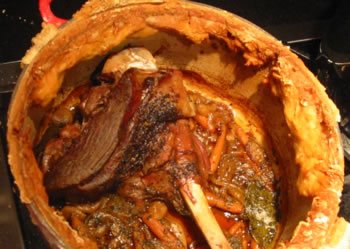
There wasn't much liquid left after seven hours, but there was some -- enough to keep the meat moist and very, very tender. There's a ton of garlic in this recipe, and everything blended nicely with a bottle of Vacqueryas.
The lemon pie worked well, too.
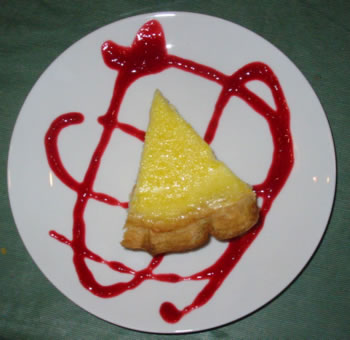
If you skip the rasberry coulis, or if you have a blender, the lemon pie qualifies as dorm food -- a dish you can make in a dormitory kitchen. (If you can cook in a dorm, you can cook anywhere) All this pie requires is squeezing some lemons, beating the juice with some sugar, eggs, and cream, pouring it into a baked pie crust (I confess! I confess! I used the refrigerated, rolled-up supermarket pie crust because Cooks' said it was OK. I had permission!) and popping it into the oven. The coulis is just frozen raspberries, a little sugar, a little lemon juice, and a shot of lingonberry liqueur.
We also made a big batch of Linda's glögg!
It's a long weekend: time to cook. But I'm not quite in the right mind set for lots of prep. Current plan for tonight:
- gigot de sept heures
- tartiflette
- celery root and apple puree
- lemon tart
I'm nervous about the seven hour lamb, which I've wanted to learn to make since trying it in Paris at Wadja. There's only the two of us, so I'm making a small half leg of lamb -- a good thing, since that's all my dutch oven will hold. But will the seven hour cooking time need to be shortened for the smaller lamb? You can't check, because the whole thing is hermetically sealed with a dough crust in order to keep steam from leaking out.
I backed off the heat from 300°F to 275°F, but I can't imagine it'll make much difference; surely, this is going it equilibrate over seven hours! When Adam Gopnick tried it, he forgot that he was cooking in Paris and set his oven to 300°C; that didn't end well. Nothing ventured...
When Linda's old job vanished along with the company she was working for, we had a late dinner of champagne and coquilles St. Jacques.
Starting on a new contract, we switched theme to côte de boeuf (Hilltop, unusually, had some of these -- and some veal bones!) with a sauce of shallots, sherry, brown veal stock, demi-glace, and a little roux, and an Australian cabernet.
A kitchen observation: you haven't really been in the weeds, I think, until you have a pear-onion chutney on burner one, butternut squash soup on burner two, a pot of daube provençal on burner three, a couple of flatbreads rising on the counter, and the chocolate tarte crust baking in the over, and the New York Times sends an email that starts
Subject: IMPORTANT TIME SENSITIVE PRICING QUESTION
How was your weekend?
Last night, I had to start some duck confit and Linda had a late-running photography class, so for a late dinner I threw together a nice garlic soup.
Start with 4c of chicken stock (I used a box of low-salt stock from the store, since I was out of home made). Peel the cloves from three heads of garlic. Add 7 sprigs of thyme, 4 sage leaves, and a few black peppercorns. Simmer for 45 minutes.
Discard the herbs. Toss the garlic and some stock in the food processor, puree, and return to the stock. Wait for Linda to get home, finish confit, watch movie.
Reheat the soup. Toss in a few bits of parma ham if you have it: I didn't, but I did have a little bit of Niman Ranch salami lying around, and it was great. Add a handful of pasta bits (I used strozzapreti). When it gets to simmer nicely, poach a couple of eggs right in the soup. Simmer until they're done, spoon into bowls, swirl in a dollop of crème fraîche if you've got it. Enjoy.
Last night, the meal I'd planned to make turned out to be impossible; the grocery didn't have the meat I needed. So I rolled with the punches and made the latest entry from Chocolate and Zucchini: Soupe de Céleri et Patates Douces au Gingembre.
This leapt to mind, because I had a little more than a cup of good chicken stock left -- stock I froze after making Butternut Squash Soup for Karen K. last month. Because we'd used a bunch of stock for the thanksgiving stuffing, there wasn't enough left for squash soup. Unlike most soups I make, it only takes 40 minutes. This thick sweet-potato soup seemed just the ticket.
It was: the celery root is a great idea. And the ginger is just enough. I added a dollop of crème fraîche to each bowl; it was great. I could try one of Clotilde's recipes every day.
If I did try one of Clotilde's recipes every day, and wrote about the experience here, this would be an example of a vow blog. Diet Blogs are probably the quintessential vow blog. Weblog tributes to friends and ancestors are vow blogs, too, like this lovely weblog about my aunt Nancy Starrels, who never saw a blog herself. Nanowrimo blogs are vow blogs, of course. You have hours to go in National Novel Writing Month.
Later this month, a quick trip to Brussels will mean an overnight visit to Heathrow. We arrive in time for a late supper, but probably not early enough to drop off our bags, take the train into London, eat, and return to Heathrow.
Is there an interesting, or good, option for dinner near Heathrow? Email me.
Food Blog S'cool (clever idea, sometimes marred by too much discussion of blogger and too little food writing) has a thread inviting people to post pictures of their kitchen. Here's mine.
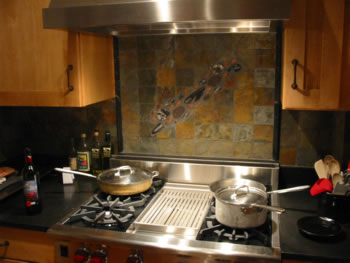
They use technorati tags to find backlinks like this: [kitchen+photos]. The use of tags for community discovery is intriguing.
Via 101 cookbooks.
Perhaps the seasonal produce thing can be carried too far, but it's getting to be the dreary season and all sorts of colorful squash are available for prices you don't see in grocery stores anymore.
It was educational.
Duck confit with carmelized pear: if you leave a sauté unatteneded because your guests are telling a really funny story, you'll be sorry. But don't give up too soon, because it turns out that your guests like the burnt bits.
Squash garlic soup with ginger créme fraîche: Hubbard squash might not be substitutable for pumpkin 1:1. The soup was a bit thin. This is hazard of squash shopping when you know nothing about squash. McGee
Steak a poivre: you need a hot pan to sear the meat. You deglaze with a little armagnac after searing the meat. The pan is hot: the brandy vanishes instantly. You remark: something is not right.
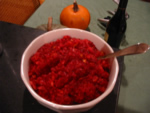
Cranberry orange relish: no cooking. Hence, no lesson. (Take a package of cranberries. Rinse, Toss in the food processor. Take an orange. No, don't peel it. Rinse. Quarter. Toss it into the food processor. Add 1/2c sugar. Chop. Into bowl. Chill 30 minutes. Improve your Thanksgiving several degrees. Here endeth the lesson)
Roasted shallots, pear vinegar: improvisation only works when you're in the right key. The roasted shallots are already sweet and fruity; wrong vinegar.
Salt crusted baby sweet potatoes: still good.
Squash gratin: straight out of Marlena Spieler's Vegetarian Bistro, a superb little cookbook Megnut recommends and that is unjustly out of print. Fortunately, amazon
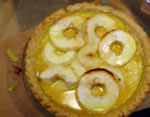
Tarte alsacienne: Tasty: didn't set. The Cortland apple slices, buttered and sugared and baked for forty minutes and then added to a prebaked pie shell, did have a nice texture and did hold together. The custard never did cohere. Is the answer simply longer baking ?
I found some baby sweet potatoes in the Cambridge Museum Of Fruits and Vegetables the other day, and improvised a terrific and easy way to cook them.
Preheat the oven to 425°F (a hot oven, in other words).
Put the little sweet potatoes in a baking dish that holds them snugly.
In a medium mixing bowl, whip 2 egg whites until stiff.
Fold in about a pound of kosher salt. (Doesn't have to be kosher salt -- any coarse salt will do. Kosher salt is probably your least expensive option)
Pour the salt mixture over the potatoes, smoothing it down to form a crust. Into the over for an hour, maybe a smidgeon less.
Remove from oven. Break and discard the crust. Eat the salty, roasted, and smoothly sweet little sweet potatoes. Exclaim over how much better this is than the usual over-sweet crumbly casserole.
A bunch of the WebZine crowd blogs about food. (A bunch blog about sex, too -- this is San Francisco. It does seem that the sex bloggers are orthogonal to the food bloggers.)
Particularly striking was Heidi Swanson, who was part of a panel on building and managing community. (What? No Derek?) She runs 101 Cookbooks, which today is featuring a recipe for salt crusted potatoes that I really want to try.
I tried to draw her out after the talk about my perception that food writing is changing, undergoing the sort of revolution that Julia Child ushered in, or Rombauer, or Mrs. Beeton for that matter. I think her own recipe captures one of the essential parts of the new style: instead of telling you what to do, her little essay on baby potatoes begins by telling you what she wanted, and the proceeds to explain what she tried and finally why the right answer works.
Ironically, her final answer is just about identical to a recipe I was staring at a few weeks ago, for potatoes in croûte sel, in Bourdain's Les Halles Cookbook. I didn't make the recipe, though, because I didn't know what was intended -- is the crust meant to be eaten, or is it just a means to the end? Though Swanson takes a longer path, at its end we know that she wants to do, and we can see in her photographs that the crust is a scaffold and that the three cups (cups!) of kosher salt are for process, not for dinner.
There's an interesting revolution brewing in food writing. Look for the same revolution to overtake technical writing in a few years.
Dinner tonight at Pazzia, recommended by Pat Delaney for last year's Tinderbox dinner. They couldn't fit us into their plans last year, but tonight they had a little table free. The bruschetta was everything you'd want, with really nice tomatoes and good, fragrant basil. The seafood risotto was good, too, with subtle fire and very fine shrimp that almost made up for rice that might have had just a trace of chalkiness. But perhaps I was being fussy....
Update: Martin Spernau says the change is already afoot.
[webzine2005]Last weekend, we had a barbecue, and then another barbecue.
Dessert the first night was a chocolate pecan tart. It begins with a big 8oz chunk of Valrhona's Manjari chocolate, roughly chopped by hand. Boil 2 cups of heavy cream, pour that over the chocolate, wait five minutes. Then stir in 2 egg yolks, a little vanilla, and 5oz of just-toasted pecans.
Pour the mixture into a baked tart shell (thereby hangs a tale for another day, since this was my first attempt at a tart crust) and refrigerate for a couple of hours. Seriously chocolate.
Also effective was the appetizer of grilled flatbread, topped with garlic-chile oil, grilled dates, and a little goat cheese.
Friday night, I tried a fish recipe from the Cafe Pasquales cookbook. (Pasquales is a Santa Fe institution, and in recent years their cooking has been extremely interesting). It was an interesting dish because it has two sauces and uses them to really good effect.
On the plate, we have a crema that starts with 1T each of cumin and coriander seed, roasted in a very hot dry pan until brown and smoky and then mixed with 8oz yogurt, some lemon juice, and some cilantro. The book called for a couple of cloves of minced garlic; I went with six cloves of mexican-roasted garlic instead.
On top of the crema , we nestle a piece of mackerel, crusted with lots of oregano, salt, sugar, and pepper, and cooked 5 minutes/side in a very hot, oiled pan.
On the mackerel, we have a salsa -- essentially a home-made one-egg mayonnaise -- with lemon, a clove of garlic and some chipotle.
I expected this to be fussy, but it's really good. The salsa on the bottom with its toasted/burnt spices gives the fish a solid, smoky foundation, with hints of sweetness and smoke. The fish can be sauteed aggressively but doesn't need a lot of aggressive spice. The crema gives it bright notes and spice.
My cooking has changed a lot this year. I'm using stock a lot more than I used to. I've got some adequate veal stock in the refrigerator now, for example, and some demi-glace left in the freezer.
Question: where do you keep your stock? I need a couple of good containers for storage. I suspect those Nalgene reagent bottles we used to use for dilute hydrochloric acid would be perfect, but what works for you?
Last night as I left for home, I simply couldn't figure out what to cook for dinner. The wolf is nosing around the door these days, so it was of necessity scrappy affair.
Strozzapreti: I had about 1/3 of a bag of some very good dried pasta -- not enough, really, for dinner. And I had some leftover roast garlic from Saturday night. So, I very gently heated five cloves of roasted garlic in 2T olive oil and 1T oil infused with chilli peppers, and cooked up the strozzapreti for a primi. (Strozzapreti means "priest strangler". Who knew? Thanks to Antonio Deroma for the spelling correction and for proposing Tinderbox Weekend Italy.)
Grilled Tuna with mango chutney, pistachios, and coriander: We had half a bunch of fresh coriander on it last legs, and the fish counter was running a special on tuna. So I seasoned a hunk of tuna with kosher salt, some sugar, and some black pepper and dropped it on the Wolf grill for about ten minutes. Then I painted each side with magno chutney, dredged it in chopped unsalted pistachios I happened to have lying around, and finally dredged it in the chopped fresh coriander.
String beans: quickly sauteed in a nonstick pan with a small bit of butter, then finished with a bit of sherry vinegar.
Strawberry clafoutis: Last Friday, Linda went to the farm store for fruits and vegetables. It's a good time to buy strawberries. She did: she bought a whole box, six pints. So, I've been doing lots of things wit strawberries, and we're down to the last survivors. Linda picked them over, sliced them in halves and quarters, and splashed them with some triple sec. I whisked 3 eggs, then beat in 4T of sugar, and then added some vanilla and 4T of flour. Fold in the berries, turn into a couple of chilled, buttered ramekins that were lightly dusted with sugar, and then right into a 450° over for 40 minutes.
The best part: other than $10 for a hunk of tuna, everything was either an odd remnant or a leftover on its last legs. All improvised, but everything was OK. The tuna's a nice, if unexpected, combination.
For a late dinner tonight, I had a plate of prosciutto with slivers of fresh figs, crumbled bleu cheese, and some rocket. This is a nice combination, one I'd like to remember for guests since it doesn't require a ton of last-minute prep and would work either before or after a meat or a fish course.
Yesterday we stopped at a bakery that offered fresh duck eggs at very moderate prices. Today, I tried a Thai duck omelet with red-cooked pork, baby corn, etc with a nice Yarra Valley Viognier from one of the vineyards through which we drove in yesterdays day of birds and grapes.

Kevin Kelley's Cool Tools recommends Parafilm for closing bottles. Now that's a name I haven't heard in many years!
That reminds me: I've always wanted to get some useful glassware for the kitchen. A couple of graduated cylinders would be really nice. A set of beakers. And I bet a 250ml Erlenmeyer would be handy for holding juices and sauces. And, yes, a roll of parafilm to seal them all.
Tonight for a send-off dinner, I'm trying Gordon Hamersley's roast chicken with lemon and garlic. It's a bit of a production: its sauce is based on double chicken stock, so it's a two-weekend adventure. So far so good; I'll try to let you know how it works out.
Note added in proof: pretty good. The small organic chickens (raised respectfully in California and Vermont, respectively) worked well, the sauce was worth the work. Not at flavorful as at the Bistro, but not bad at all.
Last night I made some duck confit, because it's tasty and because it'll be handy for Linda while I'm away. When I make confit, I always pour off and save the duck fat, because a little duck fat is much better than vegetable oil for cooking potatoes. (Sally Schneider has this one nailed: treat fats as if they were really, really expensive. Want to fry your potatoes in less fat? Use only the fat you get from your roast duck. Running out? Wait for the next duck!)
Question: when I chill the duck fat, I get another layer of water solubles, like a dark stock. Is this good to save? How should I be using it?
Answer: from eGullet, the consensus is that the water soluble layer is tasty, though it tends to be salty. Add it to soups and sauces.
Today, Megnut recalls her visit to the French Laundry and her French Laundry Fund. That led me to track down her original post, which is an outstanding piece of food writing.
I'm making dark chicken stock. Maybe a double stock. And I just burned myself, taking the mirepoix out of the oven. Burned through the oven mit. And it's only a 350° oven.
I need some fresh curse words.
Alwin says that uniform slicing is key to a good tartiflette. I'm confused, because Bourdain says "small dice", and in any case I'm not at all sure my mandoline is going to do a very good job with potatoes that have been parboiled for 20 minutes -- even had I used the right sort of potatoes.
I can vouch for the the utility of a mandoline with potatoes, though. I wonder; is it time to make a crispy potato galette again?
Tonight -- if I can still hold a pot: my first encounter with bearnaise in more than a decade. Stay tuned.
To go with last night mussels (Basquaise, this time, with roasted pepper and onion and garlic and wine), I took a stab at tartiflette.
- Preheat oven. 350°.
- Or whatever. We should have a notation for "this recipe really wants 350°" vs "you're gonna want the oven to be on, so turn it on now".
- Peel a couple of large potatoes. Boil 20 minute. Drain, cool, dice.
- I used russets, because I had them on hand. I suspect that Yukon Gold's or red Bliss potatoes would be better. I'm learning that there are really two families of potatoes, waxy and floury, and though they're both good they aren't interchangeable. We really need two names, dont we?
- Dice a medium onion. Saute until brown. Add 4oz pancetta (slab bacon was called for, pancetta was what I had). Cook until brown.
- Add the potatoes, and a cup of wine. Cook 10 minutes.
- Spoon half the mixture into a souffle dish. Add a good handful or two of cheese. (The recipes calls for a pound (!) of reblochon, which is currently out of stock at the museum. I ended up using about 3oz of parmesan and a little creme fraiche) Add the rest of the potatoes. Top with some more cheese. Oven, 20 minute.
Eat. Drink nice wine. Worry tomorrow about serum cholesterol, which may in any case be highly overrated and not tied to dietary cholesterol anyway. And you aren't gonna eat this every day.
The interesting thing: I have absolutely no idea how this is supposed to look or taste. Pretty much like Clotilde's parmentier, but there I had a picture and there weren't enough ingredients or steps to wander very far from the straight and narrow of Clotilde's intention. Here, I'm wandering so far that I might not even be in the right township. It's late, the store has no reblochon, what's in the frig?
Last night I didn't get to hear Brustein's play-in-progress, Spring Forward Fall Back. Argh.
So, I wound up making Sally Schneider's
Today, Parisian Clotilde has a recipe for banana bread, derived from my local vegetable market. It's a small world.
Last week, after getting MapView running in Tinderbox/Windows, I dropped by the wine store and asked them to pick out a selection of inexpensive 2000 Bordeaux. (One of the discoveries of the France trip last year was that Bordeaux isn't necessarily grand and expensive) So, with the duck, we tried a bottle of Chateau Lagrange Les Tours, which seems to me to be a lovely $8 wine.
Another Hypertext Meeting dinner note: Kung Fu Kitchen, a 'net movie by Jeffu Warmouth.
Last night, before Finding Nemo and The Lady Eve and after a very nice Beef Bourguignon, Meryl made a bunch of Clotilde's lovely chocolate truffles. They were great.
Note to North Americans: Meryl reports that the ganache required rework with extra cream, and that a melon scoop is the Way To Go.
Celebration via weblogs. I wanted to get you a picture, but the last batteries of 2003 were too pooped to pop.
Torill makes a gingerbread house, and seven kinds of cookies. Jill makes a gingerbread house, too, and blogs a cool Parisian cooking weblog. Just back from Norwegian Christmas porridge (yum!) at Elin's. And, tomorrow morning, Dori Smith's french toast.
Alwin has cheesecake, too.
I'm glad those gingerbread people don't need to worry about the housing shortage!
Iron Chef at Hypertext '04?
Update: Now, Elin has a gingerbread house, too!
We had so much snow yesterday, that even natives of Bergen got stuck in our driveway. Twice.
I hear that Malden got 25 inches (63cm) of snow.
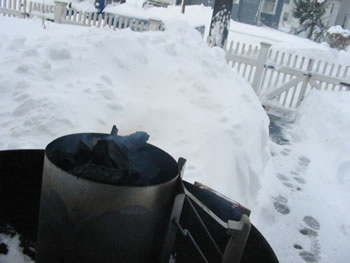
This extra, unexpected foot of snow posed an interesting set of cooking problems. My planned Sunday morning marketing was impractical, so the menu needed drastic revisions. Who knew how many people might be unable to come? I'm thrilled that everyone braved the snow, and all made it to Malden save for poor Professor Blustein, who was stuck at Logan.
When the nice little fire on the grill turned out to be incapable of melting snow, much less cooking the turkey, I got worried. This was a mistake; I ended up building the fire too hot and spent the rest of the afternoon trying to moderate the fire with smoke chips and vent.
Years ago, I gave a memorable dinner party in a newly rented apartment where, to avoid this, I gradually turned up the oven bit by bit. This was safe, and the roasted filet was tasty, and the dinner was three or four hours late. We're always fighting the last war.
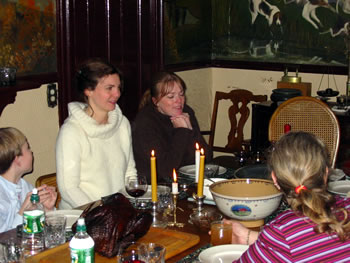
Thanksgiving is about memories, and so we wind up with too much baggage and too much food. Ritual dishes, dishes we always like, dishes we want to attempt, dishes that we always make because Aunt Hazel of blessed memory was once thought to like them. Linda and I descend from two separate traditions that separately insist on cooking too much. This time, it was:
- garlic mushroom soup
- snow-grilled turkey
- root mousse (sp?) (rodmos in dansk)
- charred onion salsa
- lemon string beans
- "Alwin's roasted carrots"
- stuffing
- cheese and cherry bread
- chocolate pecan pie
- lemon tart
- apple cranberry cobbler
It's berry season. But, you need something to put under those fresh berries, right?
Squeeze a lemon. Peel some of the zest, chop, add it to the juice. Add 4tsp of sugar, and two eggs. Whisk. Then plop it in a double-boiler (or a heavy saucepan inside a water bath in your big skillet) and stir for five minutes. It will thicken suddenly. When it does, you're set.
Cool the lemon curd. Stir in a little creme fraiche if you have some lying around. Spoon into bowls, put the berries on top. Eat. Smile.
Well, tonight we met Jacques Cagna, a really fine chef, at his rôtisserie en la Face. It's very, very impressive. And densely packed, in the textual sense, from Chagall posters on the walls to the pastilla (b'stilla) with guinea fowl, honeyed onions, and a very refined sauce in a delicate pastry crust. Not to mention the wild snails from Burgundy: no effete intellectual farm-raised snails for us! And a charming Brouilly.
Last night was Allard, and a plainly spectacular shoulder of lamb, followed by an even more spectacular apple tart that was carefully designed to be (a) delicious and (b) inform you, if you cook, that this particular tart had to have been prepared minutes before, just for you, because there's not enough thermal capacity in that thin crust to keep it this hot for more than a minute without turning it all to caramel and charcoal. Nice chats with our neighbor, too, who turned out to be Jane Smiley's proud uncle, and though a Cardinal fan had intelligent observations to make about the excellence of Don Kessinger. And a simple St. Estephe.
The Red Sox have clinched the wild card.
As the late Ken Coleman would say, "Mercy!"
The problem with Fairly Fancy cooking in England, in my experience, is that it gussies up what doesn't need it, and at the same time is leaves bare what really cries out for some thought and skill. (Really Fancy and Really Plain cooking in England, on the other hand, each careen from wonderful to truly bad, usually without warning)
My lamb last night was served on a bed of aubergine and something else, with lots of spears of toasted something-or-other scattered artfully about. The lamb didn't need this -- certainly not from where I'm sitting. Good lamb is nice, this was good lamb, probably local lamb. The palest lamb I remember, but very good,
The side dish of various vegetables, on the other hand, was silly in its lack of adornment. Plain potatoes, of no particular variety or interest, boiled. Once-adequate snow peas, steamed into oblivion. Plain carrots, indifferent at best, sliced lengthwise and steamed. And steamed broccoli.
I don't get it. Why not roast the carrots with a little pepper and a herb? (We're in Sherwood Forest; surely they can have a herb garden?) I'm down on broccoli this week, but it's a sauce magnet -- and, hell, you're a restaurant, you've got drippings of every sort. This is cheese country as I recall; use a touch of it. Or a flavored oil. Sage, rosemary, or thyme?
And this was a very unbusy time and a small restaurant; it's not like the kitchen was pushed over the edge.
Cardiac care nurse Al Hawkins just taught me something about cooking. He blogged that roasted carrots with tarragon was a Good Idea.
The previous night, I'd run out of vegetables and was reduced to preparing a pear sauce for the pan-fried trout in order to have something green (braise with olive oil, pepper, star anise, vanilla bean, a little leftover desert wine, and finish with a teaspoon of poire william).
So, to make up, a brought home a Peter Rabbit bunch of carrots from the Cambridge Museum of Fruits and Vegetables.
Quick: what's the difference between baking and roasting? As I understand it, roasting is about two things: high heat, and salt. We're talking about a hot, hot oven.
I washed and trimmed the carrots and popped them into a 475F oven with a very little bit of olive oil, lots of salt and freshly-ground pepper, and a smidgeon of butter. 45 minutes, then top with a handful of chopped tarragon.
Very interesting! The carrots were not even slightly sweet; spicy, savory, delicious, and nothing at all like the carrots you get in stews. If I'd had them in a restaurant, I'd have wondered what strange Asian vegetable this was, that looked so carrot-like.
The core problem in barbecuing ribs (spin not, O ancestors!) is cooking them enough. If you leave them on the grill for enough time to render out the fat, they end up burnt. This is bad.
My rehearsal dinner was held at the Golden Dome Hickory Pit, as I mentioned once before. You had to say the magic words there, to get the right ribs. The magic words were "extra crispy, basted in hot sauce, with hot sauce on the side."
My former approach involved parboiling the ribs in a rich spice mixture. This reduces the fat. But you have two problems. First, you need a lot of water to parboil a rack of ribs, which means you need a LOT of chili and paprika to season the water, and spices are not cheap. This is bad. And, after you take the ribs out, you have boiled meat. This is bad, too.
New approach: slather the ribs with your secret sauce. Then wrap them tightly in tinfoil. Wrap them like you're going to poach them in the dishwasher. (Yes, my mother taught me to poach fish in the dishwasher,) I mean wrap, not loosely cover. OK?
Now, toss them on a baking sheet or whatever, and pop them into a warm (325F) oven for 90 minutes. Yes, I said 90.
Take the ribs out. Open the package (careful -- live steam!). Remove ribs. Discard the copious quantities of hot fat (careful -- the color it's extracted from the paprika is a really effective oil pigment that will turn anything orangish. Permanently. Trust me; I'm a chemist; I've done the experiment.)
Now, put the ribs on the grill. (We're barbecuing, remember -- not grilling. Indirect heat) Baste them with secret sauce from time to time. Wait 30 minutes. Turn them over. Wait another 30 minutes. Yes -- a whole hour more.
Astonishingly, the ribs were not burnt. But they were as lean as ribs can be. Very, very nice. (Thanks, Sally Schneider, A New Way To Cook, for the basic approach)
by Sally Schneider
Sensible, thoughtful recipes that work, this is a really good cookbook that's also interesting and thoughtful. The core of the book is teaching you to improvise; instead of giving you lots of recipes, it describes a base technique (e.g. "braising small fish"), explains what the parameters are, and shows lots of variations. It's like a jazz book for classical pianists; Schneider assumes you know the basics and shows you how to improvise.
One of the most interesting things here is Schneider's treatment of fats and sugars as something to be relished, not as a plague. Growing up, I was taught to abjure saturated fat and sugar with a nearly religious fervor. Schneider tries to step back and consider, to think about exactly why we like some foods and what it means to us when the food we like isn't good for us.
For example, let's think about crispy fried onions. Tasty, but bad, right? Schneider says, go ahead. But, instead of treating the dish as an indulgence or trying to make a bad imitation without the fat, Schneider has you use a pastry brush to coat each and every onion piece with extra-virgin olive oil (or, she suggests, duck fat!) The upshot is, you use less fat, and it all goes where it'll do the most good. (You sweat the onions for 5-10 minutes under a tight cover, and then you saute them to drive the water off; this gives you the effect of deep frying without the oil bath). Schneider likes to encourage you to enjoy lots of different fats and sugars, evening out the dietary strain, and she treats them like expensive ingredients, things to be carefully doled out, savored and treasured.
I'm back from that rare event, a week without hypertext. Santa Fe, old friends, ruins, serious art, serious food. Paris, with cactus.
The key dish of the trip -- in which we threw sense and sensibility to the winds whenever mealtime approached -- was a plate of cheese enchiladas at Pasquales. Pasquales has been there forever, it's always been quite good, but these enchiladas were a revelation. A sauce with four different chiles, each of which could be tasted distinctly and separately. A very impressive chicken molé, too. Inspired by this level of complexity, I bought so many cookbooks from the Santa Fe Cooking School that our baggage home was overweight.
Coyote Café was very fine indeed. SantaCafe still does amazing calamari. Anasazi had a reinterpretation of frybread that bears no resemblance to any Navaho taco I've ever met but which contrives to suggest -- with its smattering of saltiness and spiciness and crispiness and a topping of roasted peppers -- why spending a whole day with a metate appealed to the inventors of corn. Tecolote still has wonderful blue corn and piñon pancakes.
The star meal was Geronimo at the end of a long day prowling the innumerable galleries of Canyon Road. Starting with seared foie gras -- not my usual style, but if you're going to try a Fabled Dish, best to do it where they know what theyr'e doing. Then, a tenderloin of elk -- sweet, perfectly cooked, spicy, just right. I don't much like venison, as a rule, but elk is their signature dish and when else are you going to try elk at a restaurant where it's not just a novelty? Besides, I'd been busting the budget all week, and it was a little less than the beef -- another sign of seriousness.
From time to time, I remember that I'm a certified chemist. On the occasional cold winter night, I even miss the lab. When that happens, I cook. (When it doesn't, I cook anyway. Eating is good)
Right now, we're about to rebuild our kitchen -- a good thing, since our current kitchen is the worst I've had since grad school. As of last Saturday (Delmonico steak on a bed of gorgonzola onions, with rosti potatoes and broccoli) our kitchen has been without a dishwasher. I learned to hate washing glassware roughly three years before I learned what a garlic clove was.
Today, Tekka food writer Meg Hourihan's favorite cookbook, The Vegetarian Bistro, arrived. I tried the broccoli au sauce roquefort, I need to learn to judge when broccoli is done; I was way behind the pitch on Saturday and way out in front today. The home-roasted cashews in the recipe were a win; verdict is out on the overall effect.
Talk about the flavor of the crackling of the pork,
Nothing could have been so strong
As the glorious effluvium that filled our house
When the gorgonzola cheese went wrong.
Megnut's favorite cookbook is out of print, but Amazon quickly and inexpensively found me a pristine copy from a bookseller in Traverse City, Michigan. Traverse City is not on my beaten path, and I'm no vegetarian; that's why Amazon's venture into used-book matchmaking may be one of the watersheds in the history of literature.
I read Peter Meerholz's carbonara recipe yesterday, and ran straight to the store to try it. The cheese steward at the Cambridge Museum of Fruits And Vegetables hadn't heard of Mezzo Secco. "Show me the recipe!", he said, glanced at it, and he handed me an Italian cheese he though would work well. It was delicious. The red pepper is important. I used a bunch of fresh cilantro instead of basil, an improvisation that turned out fine.
I also managed a nicely seared dish of Gloucester scallops, marinated in lime and ginger this week. Sometimes its fun to be back in the lab.
Media scholar Torill Mortensen is hard at work in the kitchen, introducing visiting Greek students to Norway's summer food. She writes about the vegetables that grow in Norway's blonde nights, of venison with fresh chanterelles, of fenalår. I'm already hungry.
"In desperation I started baking cakes. No Norwegian housewife can endure having her cakes rejected, that is the final test of your skill in the kitchen: to be able to make a light, tasty, elegantly presented and irresistable cake. Finally, I found something they could endure. So the girls here have, for 9 days now, been living on bread, lefse and cakes - chocolate cake, apple cake, cream cake, a progression of cakes which they never sit down to eat. They eat on the run: grab a packed meal and then spurn any healthy looking food we might have packed for them, and clean out the cakes.
I've got to get an invitation to Norway, one of these days.
One of my favorite summer concoctions is really easy to make.
Take a handful of fresh cilantro and toss it in the Cuisanart with a handful of walnuts, pecans, or whatever nut is handy. Chop fine, and spread on a plate.
Get a small bowl of good, not-too-hot mango chutney.
Grill some sausages. Spicy is good; the fresh, spicy chicken and turkey sausages from the Cambridge Museum of Fruits and Vegetables are fine, and I like kielbasa.
Take a bit of sausage on a fork or skewer. Dip it in the mango chutney. Then dip it in the crunchy cilantro. Eat. Repeat.
My cookbook claims this was a 19th-century Milwaukee tavern food. Surely this is madness -- mango chutney in Milwaukee? Or is this a typical northern-European dish?
Go to Home Depot. Find a nice hunk of cedar. Ask the nice fellow to lop off about 16" for you. Hop over to Turner's Fisheries. Get a nice 14" hunk of Atlantic Salmon filet. Skin on, thanks. Rush it home, marinate a bit in vermouth, ginger, lime, and pepper.
Light the Weber grill (hardwood charcoal, please). While it gets going, have a bottle of a nice California Chardonnay.
Drop the plank on the coals. It will char nicely in a surprisingly short time, Remove it; put it on top of the grill, and put the salmon on the plank. Skin down, thanks.
Cook it for about 12 minutes. The smoke rising from the board will be quite dramatic. Enjoy. Top with diced orange and lime, seasoned with maple syrup, cayenne, and a little more cumin than you might expect. Slice and serve from the plank, with a big bottle of perry .
This Thursday is Thanksgiving in the US. It's a big holiday. It works because it's a genuine holiday (unlike Mother's Day, invented by a department store) and it's secular (unlike Christmas). Religious holidays make Americans uneasy with the memory of ancient disputes, memory of a time when the Unitarians and the Quakers and the Baptists and the Methodists and the Congregationalists and the Catholics really didn't get along. (They don't get along now, either, outside the fantasy-life of a few fringe politician-evangelists)
But Thursday's the day for the annual turkey which in my heretical opinion should be cooked on a kettle grill. Put the turkey on at half-time of the first game and it will be ready when everyone arrives. Don't forget pumpkin pie. And cranberry relish (add sugar, orange, Cuisinart. Never use cans.)
I'll be in sunny New Jersey; no updates for a few days and a few hundred miles of driving.
Tonight's Iron Chef (thanks to Nancy Kaplan for introducing me Iron Chef!) was Lamb Battle, wherein an apprentice tries to unseat his former teacher and the theme ingredient (for once) is something I sometimes cook. Earlier today we had late-season grilling, with our annual Mixed Grill augmented by grilled sandwiches: goat cheese, grilled portabello, fresh basil, grilled bell pepper, grilled marinated squash, basil leaf, roasted red pepper.
Thanksgiving: Free-range turkey, cooked (as always) on the grill. Too chilly for many neighbors to notice this annual eccentricity. Rootmos. Fresh cranberries, chopped with clementines. Zaca Mesa Chardonnay. Meryl's blueberry crumble.
Topical
Tinderbox | Travel Notes project | iPhone | Iraq | Ebert | Menand | Mamet | Food | Ten Tips | epigrams | Criticism | TechnoCrit | NeoVictorian Computing